
ecommerce boxes packaging
Showing the single result
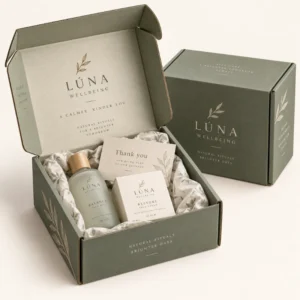
ecommerce boxes packaging describes everything that goes into sending an online order in a box, from the outer box itself to the insert, tissue, void fill, tape and label that complete the parcel. It is a practical subject, because a small change in box size, insert shape or sealing method can change how safely a product travels, how quickly an order packs, and how the customer feels on opening. Planning those parts together gives a more reliable result than choosing each part in isolation.
How ecommerce boxes packaging protects an order
Protection starts with fit. A box that is too large allows movement, and movement causes scuffing, corner damage and broken items. A box that is too small forces the lid closed, presses on the product and can split at the corners. The right fit leaves just enough room for the product plus a thin layer of protection, with the product held centrally so it is cushioned on every side. That fit should be tested with real products, including any inner retail carton, tissue or gift wrap that will actually be used.
Board strength is the second layer of protection. Single wall corrugated board suits light and medium orders, while double wall board suits heavier orders and parcels that will be stacked. Flute choice also matters: E flute keeps a mailer slim and neat, B flute adds cushioning for more fragile goods, and C flute adds still more cushioning for larger cartons. A sample packed with the heaviest product in a group will show whether the chosen board holds its shape under stacking and handling, or whether a stronger grade is needed.
Inserts, tissue and void fill
Inserts hold a product in place, tissue protects a surface and softens the reveal, and void fill stops movement in remaining space. A card insert with a cut out suits a single jar, bottle or gift item. A corrugated divider suits a multi item order, because it stops items knocking against each other. Paper void fill suits small gaps and is easy to recycle with the box. Keep each inner part purposeful, because extra layers that do not protect or present anything slow packing and add waste without improving the delivery.
Choosing void fill for different products
Shredded paper works well for light items and small gaps, while a corrugated fitment works better for a fragile item that needs to stay central. Tissue paper suits a surface that might scuff, such as a printed carton or a gift box inside the outer box. Avoid filling a box with a large amount of loose material to compensate for a box that is far too large. A smaller box, or a shaped insert, usually gives a better result and a tidier opening for the customer.
Sealing, labelling and returns
Sealing and labelling complete the protection. Tape the centre seam and ends, and tape the base as well as the top for heavier parcels. Place the label flat on a clean face, away from folds and heavy print, so it scans easily at every stage. For products that may be returned, a box that opens cleanly and reseals with tape is a real advantage, and a short returns note inside can explain how to remove old labels and reseal the parcel. That small note reduces damaged returns and makes the return journey simpler for the customer.
Branding within ecommerce boxes packaging
Branding in this context is not only a logo on the outside. It includes the colour of the tissue, the message inside the lid, the order in which items are revealed, and the tidiness of the whole parcel. A customer who opens a box to find items neatly arranged, with a short thank you note and clear care guidance, forms a different impression from a customer who opens a box to find items loose in a large amount of filler. Both parcels may contain the same product, but the experience, and the likelihood of a repeat order, can differ greatly.
Print planning should respect the packing routine. Outside print is seen on delivery, inside print is seen on opening, and a label area must stay clear in both cases. A simple design with strong contrast reads well in sorting and on a doorstep, while detailed artwork works better inside the lid, where the customer has time to look at it. Check a proof on the chosen board, because kraft board softens colour and white board gives brighter, sharper print. Small text should stay legible once the box is folded and filled.
Keeping packaging consistent across orders
Consistency helps customers recognise a delivery and helps packing teams work accurately. When the box, insert, tissue and label position are the same for a product group, packers can follow a sample packed parcel as a reference. That sample shows the box size, the insert, the void fill and the label position in one place, which reduces errors and keeps quality steady during busy periods. Consistency also helps with stock control, because the same materials are reordered in a predictable pattern.
Reviewing packaging after real deliveries
Review packaging after a period of real use, not only after a sample test. Look at damage reports, customer comments about opening, returns that arrived damaged, and packing times. Those signals often point to a small change, such as a different insert shape, a slightly larger box for one product, or a clearer label area, that improves results without a full redesign. A short review each season, or after a product change, keeps the packaging system aligned with the products it actually sends.
Ordering ecommerce boxes packaging on a quote basis
Custom packaging is made to order, so sharing the full order picture at the quotation stage helps. Send the packed sizes and weights for each product group, the box style, the insert type, the tissue or void fill preference, the print colours and the quantity. For standard boxes, allow 10 to 14 working days after final artwork approval, and for corrugated boxes, allow 12 to 15 working days after final artwork approval. Treat those periods as production time rather than guaranteed delivery dates, and allow time for artwork approval and delivery to your packing location.
For box types by product, see the ecommerce boxes collection, and for the wider packaging system, see the ecommerce box packaging collection. For custom options, see the custom ecommerce boxes collection. For a sustainable packaging range, see the eco friendly ecommerce packaging collection. You can browse the shop, learn more on the about Personalized Mailer Boxes page, and request a quote when your sizes are ready. For posting limits, check the Royal Mail size and weight guide. Delivery planning is covered on the delivery information page.
Frequently asked questions
What does ecommerce boxes packaging include?
It includes the outer box, any inner box or insert, tissue or void fill, tape and the delivery label. Planning those parts together gives better protection and a tidier unboxing than choosing each part separately.
How much void fill should I use?
Use just enough to stop movement, with the product held centrally. If a large amount of filler is needed, the box is probably too large, and a smaller box or a shaped insert will usually give a better result.
Can I make ecommerce packaging more sustainable?
Yes, by choosing a snug recyclable box, using paper inserts and void fill, keeping the label area clear, and avoiding plastic filler where paper performs just as well. A clear recycling note inside the box also helps customers dispose of it correctly.
How do I keep packaging consistent for repeat orders?
Record the box size, insert, void fill and label position for each product group, and keep a sample packed parcel as a reference at the packing bench. Review that record when a product changes, so the packaging still fits the product it sends.