
ecommerce boxes
Showing the single result
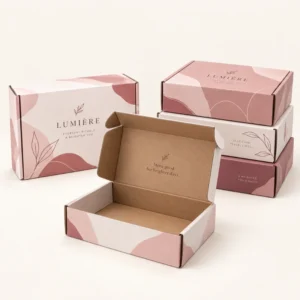
ecommerce boxes are the boxes used to send orders from an online shop to a customer, ranging from slim mailer boxes for single items to stronger shipping cartons for larger or heavier orders. They protect products through sorting, transport and delivery, carry the delivery label, and often provide the first physical impression of the brand. Choosing the right box type, size and board helps orders arrive safely, pack quickly and look professional on arrival.
Types of ecommerce boxes for online orders
The two most useful types for online shops are mailer boxes and shipping cartons. Mailer boxes are die cut boxes that fold into a neat parcel with a tuck in lid, and they work well when the box itself is part of the presentation. Shipping cartons are usually regular slotted cartons that seal with tape, and they work well for heavier orders, multi item orders and parcels that will be stacked. Many shops use both: a mailer for single items and gift sets, and a carton for larger orders or for protecting a branded inner box.
Board choice sits behind both types. Corrugated board, with a fluted layer between flat liners, gives strength without much weight. E flute is slim and neat, which suits mailers for cosmetics, stationery, folded apparel and small gifts. B flute gives more cushioning, which suits heavier or more fragile goods. C flute gives still more cushioning for larger cartons. The product weight and fragility, not the box style alone, should decide the flute, because a light box for a heavy product will crush, while a very heavy box for a light product wastes material and storage.
Mailer boxes for single items and gift sets
Mailer boxes suit orders where the customer opens the box as the main experience. A clean fold, a secure tuck in lid and a printed logo or message can make a single item feel like a gift. They also pack quickly, because the box folds into shape without a complex taping routine, and they usually arrive flat, which helps with storage in a small unit or studio. For gift sets, a card insert can hold each item in place and keep the reveal tidy, so the customer sees the set as intended rather than a jumble of items.
Sizing a mailer for a real order
Measure the product after wrapping, including any inner box or tissue, then add a small allowance for protection. The lid should close without forcing, and the product should not slide freely inside. If it does slide, add a card insert or paper void fill rather than moving to a larger box. Record the packed size and weight for each main product, so the same box is chosen consistently and packing teams do not need to guess on a busy day.
Shipping cartons for larger and heavier orders
Shipping cartons suit orders that are too heavy, too bulky or too varied for a mailer. A carton with a taped top and base can hold several retail cartons, a set of heavier items or a product with an awkward shape. Double wall board gives extra strength for heavier goods or for parcels that will travel a long distance and be stacked under other parcels. Inside the carton, dividers can separate items, and paper void fill can stop movement, which is especially important when items of different weights share one parcel.
Choosing ecommerce boxes by product
Different products need different boxes. Folded apparel needs a box that allows a neat fold without deep creasing, and a slim mailer often works well. Cosmetics in glass need an insert that holds each item centrally and protects against knocks. Books need a snug box that prevents corner damage, while electronics in their own retail cartons need a shipping carton with void fill around the retail pack. Grouping products by packed size, weight and fragility makes it easier to choose a small range of boxes that covers most orders.
Postal format is another practical check. Measure and weigh the finished parcel, not only the empty box, and compare the result with current postal limits. A box that is only slightly too large can move a parcel into a larger format, while a box that is too small can bulge and become harder to seal and scan. A short sample test with real products will show whether the chosen box keeps the parcel inside the intended format and still protects the contents.
Print, labels and the delivery journey
Print should support the journey, not complicate it. Keep the delivery label on a clean face, away from folds and heavy patterning, and keep barcodes free of print that could interfere with scanning. Outside print can carry the brand mark and a short message, while inside print can carry a thank you note or care guidance. Check a proof on the chosen board, because kraft board gives softer colour than white board, and small text needs to stay legible once the box is folded and filled.
Avoiding common packing mistakes
Common mistakes include using a box far too large for the order, reusing a damaged box, taping over the label area, and leaving empty space that allows items to move. Each mistake increases the chance of damage or a delayed delivery. A simple routine helps: wrap fragile items separately, place heavier items at the bottom, fill gaps with paper void fill, seal top and base for heavier parcels, and place the label flat on a clean face. That routine, repeated for every order, keeps quality consistent.
Ordering ecommerce boxes on a quote basis
Custom boxes are made to order, so clear details at the quotation stage help the specification stay accurate. Share the packed sizes and weights for each product group, the box style you prefer, the board grade, the print colours and the quantity. For standard boxes, allow 10 to 14 working days after final artwork approval, and for corrugated boxes, allow 12 to 15 working days after final artwork approval. Treat those periods as production time rather than guaranteed delivery dates, and allow extra time for artwork approval and delivery to your packing location.
For the wider packaging system, see the ecommerce box packaging collection, and for a related range, see the ecommerce boxes packaging collection. For custom options, see the custom ecommerce boxes collection. You can browse the shop, learn more on the about Personalized Mailer Boxes page, and request a quote when your sizes are ready. For posting limits, check the Royal Mail size and weight guide. Delivery planning is covered on the delivery information page.
Frequently asked questions
What is the best ecommerce box for clothing?
A slim mailer box often works well for folded clothing, because it keeps the fold neat and gives a tidy unboxing. Choose a size that fits the folded garment plus a thin layer of tissue, without forcing the lid closed.
Should I use a mailer box or a shipping carton?
Use a mailer when presentation matters and the order is light to medium weight. Use a shipping carton when the order is heavy, bulky, made up of several items, or likely to be stacked under other parcels.
Can ecommerce boxes be printed with my branding?
Yes, printed board is available on a quote basis. Keep the label area clear, check colour on the chosen board, and share artwork early so print areas can be checked before production.
How do I stop items moving inside an ecommerce box?
Hold the product centrally with a card insert or corrugated divider, fill remaining gaps with paper void fill, and seal the box securely. A parcel that does not rattle when turned gently is far less likely to arrive damaged.