
ecommerce box packaging
Showing the single result
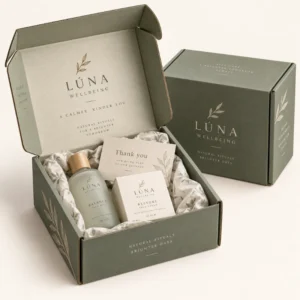
ecommerce box packaging is the complete box system used to send an online order, including the outer box, any inner box or insert, void fill, tape and label. It must protect the product through warehousing, sorting and delivery, while also giving the customer a clear first impression of the brand when the parcel arrives. A good system balances protection, size, print and packing speed, so orders leave quickly and arrive in the condition the customer expects.
What ecommerce box packaging includes
Think of the system in layers. The outer box provides strength and a surface for branding and labelling. An inner box or insert holds the product in place and can add a gift like presentation. Void fill stops movement in any remaining space. Tape seals the parcel, and the label gives the delivery information in a place that scans easily. When one layer is weak, the others have to work harder, so it helps to plan the whole system together rather than choosing a box and then trying to fix packing problems with extra filler.
Online orders vary widely, which is why one box rarely fits every product. A single cosmetic item needs a slim mailer, a clothing order needs a box that allows folding without creasing, and a gift set needs an insert that keeps each item visible and in place. Grouping products by size, weight and fragility helps a business choose a small, workable range of boxes and inserts, rather than holding a large stock of sizes that are rarely used.
Outer boxes: mailers and shipping cartons
Mailer boxes fold into a neat, presentable parcel with a tuck in lid, and they suit orders where the box itself is part of the presentation. Shipping cartons, usually regular slotted cartons, suit heavier, bulkier or multi item orders where strength and stacking matter more than a printed reveal. Corrugated board is common for both, with E flute giving a slim profile for mailers and B or C flute giving more cushioning for cartons. The product weight, the journey length and the need for inside print usually decide which style fits best.
Choosing between a mailer and a carton
Choose a mailer when the customer will open the box as the main product presentation, when the order is light to medium weight, and when packing speed matters. Choose a carton when the order is heavy, bulky or made up of several retail cartons, or when the parcel will be stacked under other parcels. A plain outer carton can also protect a branded inner box, so the brand reveal happens on opening rather than on the doorstep, which some brands prefer for higher value orders.
Inner packaging that protects and presents
Inserts do two jobs at once. A card insert with a cut out holds a product centrally, a corrugated divider separates items, and a paper wrap protects a surface that might scuff. Tissue paper softens the reveal and can add colour without plastic, while a small card inside can carry care guidance, a thank you message or returns information. Keep inner packaging tidy and purposeful. Extra layers that do not protect or present anything can slow packing, add waste and distract from the product.
Branding ecommerce box packaging without slowing packing
Print is often the first thing a customer notices, but it should not slow the packing bench. Outside print can carry the logo, a simple pattern or a short message, while inside print can carry a welcome message or a product story that is seen at the moment of opening. Keep the label area clear, keep barcodes free of patterning, and avoid print over fold lines where ink can crack. A simple design with strong contrast usually reads better in a busy sorting environment than a very detailed design.
Consistency helps packing teams as much as it helps branding. When the box size, insert and print are the same for a product group, packers learn the routine quickly and errors fall. New packers can follow a sample packed parcel for each main product, which shows the box, the insert, the void fill and the label position in one reference. That sample also helps with quality checks, because a packed parcel can be compared with the sample before it is sealed.
Print areas to plan early
Plan the outside, the inside of the lid, the sides and any insert as separate areas, even if the same colour runs across them. Text placed too close to an edge can be lost at a fold, and small text on a side panel can become hard to read once the box is assembled. A clear hierarchy helps: brand name first, product name second, and supporting detail in a smaller but still legible size. Check a proof on the chosen board, because colour on kraft board looks softer than the same artwork on white board.
Finishes that suit online orders
Matt lamination gives a soft, understated surface and reduces glare, while gloss lamination makes colour look deeper. Foil can add a reflective accent for a logo, and embossing can add a raised texture that customers notice on opening. Use one or two finishes with intent, rather than adding every option, because restraint usually reads as more premium than a crowded surface. For a recyclable system, ask how any finish affects recycling, so the final specification matches the message on the pack.
Ordering ecommerce box packaging on a quote basis
Custom packaging is made to order, so clear details at the quotation stage shape the specification. Share the packed sizes and weights for each product group, the box style you prefer, the insert type, the print colours and the quantity. For standard boxes, allow 10 to 14 working days after final artwork approval, and for corrugated boxes, allow 12 to 15 working days after final artwork approval. Treat those periods as production time rather than guaranteed delivery dates, and allow extra time for artwork approval and delivery to your packing location.
For box options by product type, see the ecommerce boxes collection, and for a related packaging range, see the ecommerce boxes packaging collection. For custom options, see the custom ecommerce boxes collection. You can browse the shop, learn more on the about Personalized Mailer Boxes page, and request a quote when your sizes are ready. For posting limits, check the Royal Mail size and weight guide. Delivery planning is covered on the delivery information page.
Frequently asked questions
What is the difference between a mailer box and a shipping carton?
A mailer box folds into a presentable parcel with a tuck in lid and suits orders where presentation matters. A shipping carton is usually a slotted carton that suits heavier, bulkier or multi item orders where strength and stacking matter most.
How do I choose the right size for an online order?
Measure the product after wrapping, add a small allowance for protection, and choose the smallest box that closes cleanly. Test a packed sample with the real product, and record the packed size and weight for future orders.
Can ecommerce box packaging be printed inside and outside?
Yes, inside and outside printing are available on a quote basis. Outside print is seen first on delivery, while inside print is seen at the moment of opening, so many brands use outside print for the logo and inside print for a short message.
How can I reduce damage in ecommerce packaging?
Use the right board grade for the weight, hold the product centrally with an insert or paper void fill, seal the box securely, and avoid overfilling. A packed parcel that feels solid and does not rattle is far less likely to arrive damaged.