
sustainable packaging for ecommerce
Showing the single result
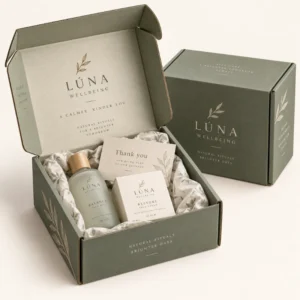
Sustainable packaging for ecommerce is the set of boxes, mailers, tapes and fillers an online seller uses to send orders with less environmental impact, without letting products arrive damaged. It focuses on fibre based materials, close fitting sizes, simple constructions and clear disposal guidance for the customer. The best version is not the lightest possible parcel, but the parcel that uses the least material that still does the job reliably.
How sustainable packaging for ecommerce is chosen
Choosing sustainable packaging starts with the product, not with a material claim. A soft garment, a glass bottle, a book and a skincare set all need different protection, and a single material will not suit all of them. Start by listing what each product needs: protection from impact, from moisture, from crushing, or simply containment. Then choose the simplest fibre based construction that meets those needs, and test it before committing to a large run.
The second step is to look at the whole parcel, not just the outer box. Tape, labels, inserts, void fill and any inner box all affect whether the parcel can be recycled easily. A corrugated box sealed with paper tape and filled with paper is straightforward to recycle. The same box sealed with plastic tape and filled with plastic air pillows is less so, even if the box itself is recyclable. Keeping all parts fibre based, where practical, makes the customer journey simpler.
Box styles that work for online orders
Mailer boxes suit products that also need presentation, because they open like a gift box and print well inside and outside. Postal boxes suit straightforward shipping, where protection and a clean seal matter more than presentation. Book wraps suit flat items, because they fold closely around the product and reduce empty space. Choosing the style by product shape, rather than by habit, avoids oversized parcels and unnecessary fill.
Mailer, postal and wrap styles compared
A mailer box is best when the opening moment matters, such as a gift, a subscription set or a first order. A postal box is best for a single robust item or a multi item order that needs a strong, simple shipper. A book wrap is best for flat, firm items that would rattle in a deeper box. Many sellers use all three across a range, matching each product to the style that fits it best.
Sizing, fill and weight
Size is the hidden driver of waste. A box that is too deep needs fill, a box that is too wide lets products slide, and a box that is too tall may push the parcel into a larger courier size. Measure the product as packed, including any inner packaging, and allow only a small clearance. If the range includes many sizes, a small set of box sizes, each used for a group of similar products, is usually more practical than a different box for every single item.
Materials and print for sustainable packaging for ecommerce
Recycled corrugated board is a strong starting point, because it is protective, printable and widely recycled. Kraft board suits a natural brand and often needs no coating. White board suits colour rich artwork and gives a clean, bright base. For cushioning, corrugated wrap, paper void fill and paper tissue all protect without adding plastic. For sealing, paper tape with a water activated adhesive gives a strong seal and stays fibre based.
Print should be planned with recycling in mind. Simple artwork, water based inks and a clear brand mark usually print well on kraft and white board. Dark, full coverage print uses more ink and can look heavy on kraft, so a lighter design often works better. If a finish is needed, a matt finish is usually a safer choice than a thick gloss laminate, because it is less likely to interfere with recycling and it resists fingerprints during handling.
What to avoid in a sustainable parcel
Avoid layers that add no protection, such as an outer box around an already strong retail box, unless the retail box would be damaged in transit. Avoid mixed materials that cannot be separated easily, such as a plastic window, a foil pouch inside a card box, or a foam insert glued to the board. Avoid oversized inserts and duplicate leaflets, because they increase weight and waste without improving the customer experience. Each part of the parcel should earn its place.
Keeping claims honest and clear
Claims on the box should match the parcel as a whole. If the box is recyclable but the tape is not, do not describe the whole parcel as recyclable without qualification. State the material, the recycled content if known, and the disposal route in plain language. A short note such as please recycle this box with paper and card helps the customer act, while a vague green claim helps no one and can damage trust.
Handling fragile and liquid products
Fragile and liquid products need more care, and sustainability must not come at the cost of breakage. Use dividers to separate glass items, corrugated wrap to cushion corners, and a snug inner fit so nothing moves. For liquids, check that closures are secure and consider a paper based absorbent layer inside the box, rather than a plastic bag, where the product allows. Test with a real packed parcel, including a drop from bench height, before approving the specification.
Ordering and running sustainable packaging for ecommerce
Order with a clear specification: product dimensions and weights, box style, board type, print design, tape and fill, and quantity per run. Corrugated lead time after final artwork approval is 12 to 15 working days, so build that into launch and seasonal plans. Keep a sample of the approved parcel, packed with real products, as a reference for future runs, so that a change in board or size is noticed before it reaches customers.
Review the range regularly. Products change, suppliers change, and a box that was right last year may no longer fit. A short annual review, checking sizes, damage rates, return rates and customer comments about packaging, will show where material can be saved and where protection needs to improve. Small changes, such as a closer box size or a paper tape switch, often add up to a meaningful reduction over a year of orders.
Related packaging and guidance
For the companion tag, see the sustainable ecommerce packaging collection, and for the wider online range, see the ecommerce packaging collection. For a strong printed mailer, see the custom mailer boxes collection. For UK packaging duties, see the GOV.UK packaging producer responsibilities guidance. You can request a quote, browse the shop and read the delivery information page.
Frequently asked questions
What is the simplest sustainable packaging for ecommerce?
A right sized corrugated box, sealed with paper tape, with paper cushioning only where needed. It is protective, widely recyclable and easy for customers to dispose of correctly.
Should I use kraft or white board for sustainable packaging?
Kraft suits a natural look and simple print, while white suits bright colour and detailed artwork. Both can be sustainable if the board is responsibly sourced and the parcel stays fibre based.
How do I protect fragile items sustainably?
Use dividers, corrugated wrap and a snug fit, and test the packed parcel before ordering in bulk. Enough protection prevents damage, and damage creates far more waste than a little extra paper cushioning.
Can sustainable packaging work for returns?
Yes. A resealable closure or a tear strip with a second seal lets the customer return the product in the same box, which saves a second parcel and keeps the return tidy.