
printed postal packaging
Showing the single result
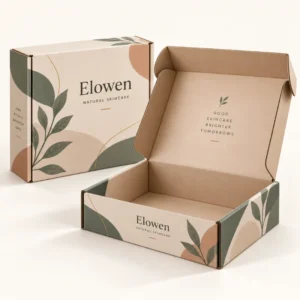
Printed postal packaging is the complete system used to send a product safely and present it well, including the outer box, any inner box or insert, tissue or void fill, tape, and the delivery label. Thinking of it as a system, rather than a single box, helps because each part affects the others: a box that is too large needs more void fill, a label placed over busy print is harder to scan, and an insert that does not fit will not protect the product. When the parts work together, the parcel protects, opens cleanly, and looks intentional.
What printed postal packaging includes
The outer box is the most visible part, and it is usually a corrugated mailer or postal box printed with a brand mark. Inside, there may be a retail box that carries product details, a card insert that holds items in place, or tissue that wraps the product and adds a sense of care on opening. Void fill, such as shredded paper or paper cushioning, fills gaps and stops movement. Tape seals the parcel, and the delivery label carries the address and any carrier marks. Each part should be chosen for the product, the journey, and the customer who will open it.
A system approach also helps with consistency. If the outer box, tissue colour and insert style stay the same across orders, customers learn to recognise a parcel and a packing team can work faster. It also helps with stock control, because fewer variations mean fewer items to store and fewer chances of running out of a key part during a busy period. Start with the product and the most common order size, build a system around that, and add variations only where a product genuinely needs a different size or level of protection.
Outer boxes in a postal system
The outer box should be sized from the product as packed, including any inner box and cushioning. A snug outer box protects better and uses less void fill, while a very large outer box can allow the inner contents to move and can increase parcel size. Corrugated board is the usual choice, with E flute giving a smooth print surface for lighter parcels and stronger board suiting heavier goods. Print on the outer box should be bold and simple, with the main brand mark on the largest panel and a clear area left for the delivery label.
When an inner box is worth adding
An inner retail box is worth adding when the product needs shelf presentation, when several items form a set, or when the product itself is fragile and benefits from two layers. The inner box can carry product details, scent names, care notes or ingredients, while the outer box carries the brand and protects in transit. Check that the inner box and outer box fit together without forcing, and that the inner box cannot slide inside the outer box when the parcel is shaken gently.
Inserts, tissue and void fill
Inserts hold products in place and prevent items from scratching each other. A card insert with cutouts can hold bottles, jars or tubes upright, while a simple divider can separate items in a gift set. Tissue adds a layer of care and can protect surfaces, especially for printed items, ceramics or glass. Void fill should fill gaps without crushing the product, and paper void fill is often the simplest choice for a system that aims to be widely recyclable. Test the full system with a real order before ordering in volume, because an insert that looks right flat may not hold the product once the parcel moves.
Designing a coherent postal system
Coherence comes from a limited palette, a consistent logo placement, and a clear hierarchy across all parts. The outer box carries the main brand mark, the tissue or inner box can carry a pattern or a secondary colour, and any card inside can carry a message or instructions. Avoid using a different colour or typeface on every part, because the parcel can look assembled from unrelated pieces. A proof that shows the outer box, insert and card together is more useful than a proof of the box alone.
Print placement should also consider practical details. The delivery label needs a flat area, tape needs a surface it can adhere to, and any returns information needs to be easy to find. If a customer needs to return an item, a clear returns note inside the parcel, or on the inner card, reduces queries and makes the return easier to pack. Keep that note short and direct, with the steps in order, so a customer does not need to search a website to understand what to do.
Labels, tape and sealing
Sealing should be consistent: tape across the main seam, with a second strip for heavier parcels, and no gaps where the box could open in transit. Paper tape can suit a system that aims to be widely recyclable, while plastic tape may be needed for heavier or more exposed parcels. Test tape adhesion on the printed board, because some finishes can make tape lift. Labels should sit flat, away from folds and joins, and any barcode should be tested on a printed sample before the full run.
Opening experience and returns
Opening should be easy and tidy. A box that tears messily, a tissue wrap that sticks to tape, or an insert that falls apart can spoil an otherwise good parcel. Pack so the first thing a customer sees is intentional, whether that is tissue, a card or a neatly placed product. If the parcel may be returned, choose a box and closure that can be resealed, and avoid print or tape that makes resealing difficult. A parcel that can be opened and closed cleanly is more likely to be returned in good condition.
Ordering printed postal packaging
Ordering a postal system starts with a list of parts: outer box size and board, inner box or insert if needed, tissue or void fill, tape, and print coverage for each printed part. Share the packed product size and weight, the most common order combination, and any seasonal variation. Corrugated lead time after final artwork approval is 12 to 15 working days, and standard lead time after final artwork approval is 10 to 14 working days for card parts, so plan the system as a whole rather than ordering each part separately. The printed postal boxes collection covers outer boxes, and the printed mailing boxes collection covers lighter mailing formats. You can request a quote, browse the shop, and read the delivery information page for planning.
Recycling and waste reduction
A postal system that uses paper and board for most parts is usually simpler for customers to recycle, provided the parts are clean and dry. The most effective waste reduction is often size: the smallest outer box that still protects the product uses less board and less void fill on every order. Avoid adding extra parts that do not protect or present the product, because each extra part adds cost, packing time and waste. A short recycling note inside the parcel can help, but keep it brief and honest.
Shipping printed postal packaging
Printed postal packaging is a shipping system, not just a single box, and each layer has a shipping job. The outer shipping box carries the delivery label and the transit protection, while any inner retail box carries the product presentation and details. Size the outer box from the inner box as packed, add void fill or an insert that stops movement, and seal and label the outer box clearly, so the retail presentation inside arrives clean even after the outer box has been sorted, stacked and handled.
Frequently asked questions
What is the difference between postal packaging and a postal box?
A postal box is one part of postal packaging. Postal packaging includes the outer box plus inserts, tissue, void fill, tape and labels that together protect and present the order.
Do I need an inner box as well as an outer box?
Not always. An inner box helps for retail presentation, fragile goods and multi item sets. For single robust items, a well fitted outer box with void fill may be enough.
How do I keep labels readable on printed packaging?
Leave a flat, clear area for the label, away from folds, joins and busy print, and test the label and any barcode on a printed sample before production.
How long does production take?
Corrugated lead time after final artwork approval is 12 to 15 working days, and standard card parts take 10 to 14 working days after final artwork approval. Allow time for proofing and delivery.