
custom candles boxes
Showing the single result
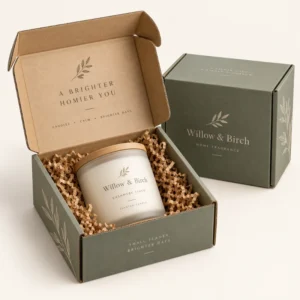
Custom candles boxes are boxes made for candles in all their shapes, from small tins and tealights to tall pillars and heavy glass jars, with size, board and print matched to each candle type. In custom candles boxes, that broad coverage matters, because a box that suits a light tin will not necessarily suit a heavy jar, and a box that suits a single pillar will not necessarily suit a set of wax melts. Choosing by candle shape, rather than by a generic box size, gives better protection, clearer scent communication and a more professional shelf presence.
How custom candles boxes suit each candle shape
Start by grouping your candles by shape and weight, not just by scent. Jars are round, heavy and fragile, tins are light and easy to dent, pillars are tall and can roll, tealights are small and numerous, and wax melts are flat, patterned and often sold in sets. Each group needs a different internal fit, even if the outside print family stays the same. A range that shares artwork but varies box size and insert by shape will look consistent on a shelf while still protecting each candle properly.
For jars, a box with a firm base and a central insert prevents tipping and label scuffing. For tins, a close fitting box with a shallow depth prevents denting and keeps the lid in place. For pillars, a tall box with a base that stops rolling and a lid that closes without pressing on the top edge is essential. For melts and tealights, compartments or trays keep pieces separate and visible. Related formats to compare include custom candle packaging boxes and custom candle gift boxes, which show how a retail box and a gift box can share a print family while serving different moments.
Jars and glass vessels
Glass jars need the most careful box design in a candle range, because weight and fragility combine. A card insert with a circular cut out holds the jar centrally, corrugated board adds cushioning for online orders, and a lidded box adds protection for the jar lid and label during shop handling. Measure with the lid on, because a wooden or metal lid changes both height and diameter, and check that the box closes without pressing on the lid. If the jar has a handle or a decorative element, allow clearance for it, because a box cut for plain glass alone will catch and scuff that detail.
Protecting labels on glass jars
Labels scuff when a jar moves against a box wall or against another jar, so a central insert and a small clearance around the label area matter. A smooth inner board surface also helps, because a rough inner surface can mark a label during packing and unpacking. Pack a sample, remove the jar, and inspect the label under good light, because scuffs that are invisible in dim packing light become obvious on a shop shelf.
Tins, pillars and smaller candles
Tins are light, so board strength is less of a concern than fit and dent protection. A close fitting box, a shallow tray or a sleeve can all work, provided the tin cannot rattle. Pillars need height, a stable base and a box that does not compress the top edge, because a crushed top edge is immediately visible and difficult to repair. Tealights and melts need compartments that keep each piece in place and present the set as a whole, rather than as loose pieces in a bag inside a box. For each shape, test the box with the real candle and with the packaging the customer will actually receive, including any tissue, ribbon or inner wrap.
Sets, samplers and discovery boxes
Sampler sets and discovery boxes are a useful way to introduce buyers to new scents, but they need dividers that keep small candles apart and a layout that shows the range at a glance. A tray with labelled compartments helps buyers identify each scent without removing every piece, while a simple divider keeps costs lower for a straightforward set. If a set will be posted, add an outer mailer or choose a stronger board, because a set box that looks perfect on a shelf can still let small pieces move in a parcel.
Materials, print and finishes across a candle range
Material choice can stay consistent across a range, even when box sizes vary. Kraft board gives a natural, handmade feel that suits soy and artisan candles, white board gives clean colour for bright and modern ranges, paperboard gives a smooth retail surface for shop display, and corrugated board gives strength for online orders. Rigid board suits premium editions within a range, even if everyday candles use folding board, because a rigid edition can stand out without changing the whole range. The key is consistency in colour and brand marks, so different box sizes still read as one brand.
Print should follow a clear hierarchy across all shapes: brand mark first, scent name second, and supporting details third. That hierarchy helps buyers who move between a tin, a jar and a pillar in the same range, because they learn where to look for scent information. Finishes can also stay consistent, with matte for calm ranges, gloss for bright ranges, foil for a logo or scent name, and embossing for a pattern that invites touch. Keep finishes to one or two per range, so the range feels curated rather than busy.
Display, storage and packing for makers
For small makers, storage and packing speed matter as much as looks. Boxes that arrive flat, fold quickly and stack neatly save space in a workshop and time during fulfilment. A consistent fold pattern across sizes helps new packers learn quickly, and a clear insert position reduces packing errors. For shops, boxes that stand upright, stack without toppling and show scent names at shelf height sell better than boxes that need to be laid flat or turned to be read. Test display as well as packing, by placing boxes on a shelf at the height a customer will see them.
Keeping a growing range manageable
As a range grows, resist adding a new box size for every new candle. Group candles by vessel size, reuse a proven box where the fit is already good, and only add a new size when a candle genuinely does not fit an existing box. That discipline keeps stock manageable, reduces proofing time and makes reorders simpler, because a familiar box can be reprinted with new scent artwork without a new structural test.
Ordering, lead times and responsible packaging
When requesting a quote, list each candle shape separately, with dimensions, weight, lid details and number per box, because a single brief that only says candles will not give a usable box specification. Include board preference, insert needs, print coverage and artwork status for each shape, and say whether boxes will be sold mainly in shops, online or both. Standard lead times after final artwork approval are 10 to 14 working days, with corrugated options at 12 to 15 working days and rigid or specialist options at 13 to 16 working days. Use those figures for planning, not as a guaranteed delivery date, and allow extra time for a growing range with several box sizes.
Responsible packaging for a broad candle range means right sizing each box, choosing recyclable board where possible, and avoiding mixed materials that complicate recycling. Brands that place packaging on the UK market can consult the GOV.UK guidance on extended producer responsibility for packaging for producer duties. You can request a quote with your candle shapes and sizes, and the about the business page gives background on the range.
Sample testing for every shape
Test one sample for every candle shape, not just for the most popular candle. Pack the real candle, close the box, lift it, tilt it gently and open it as a customer would, then check fit, label condition and lid closure for each shape. A box that passes for a tin may fail for a jar, and a box that passes for a single pillar may fail for a set, so shape by shape testing is the only reliable route to a range that protects consistently.
A simple range checklist
For each shape, confirm dimensions with lid on, board strength for packed weight, insert fit, scent legibility, barcode placement and recycling guidance. That short checklist, applied shape by shape, prevents the most common range errors and keeps future scent launches straightforward.
Frequently asked questions
Can one box design cover jars, tins and pillars?
Artwork and brand layout can be shared across shapes, but box size, depth and insert should change by shape. A shared design family with shape specific sizes gives consistency without compromising protection.
What box is best for a heavy glass jar candle?
A firm based box with a central insert and, for online orders, corrugated board or an outer mailer gives the best protection. Measure with the lid on and test a packed sample before a full run.
How should wax melts be boxed?
Wax melts suit a shallow box with compartments or a tray that keeps pieces separate and visible. A close fit prevents pieces moving, while a clear layout helps buyers see the set as a whole.
Can I order boxes for a whole candle range at once?
Yes, if you list each candle shape, size and quantity separately. Ordering a range together can simplify artwork consistency, but each shape still needs its own fit test.
How long do custom candles boxes take?
Standard lead times after final artwork approval are 10 to 14 working days, with corrugated options at 12 to 15 working days and rigid or specialist options at 13 to 16 working days. Allow extra time for multiple shapes, proofing and seasonal demand.