
custom candle packaging boxes
Showing the single result
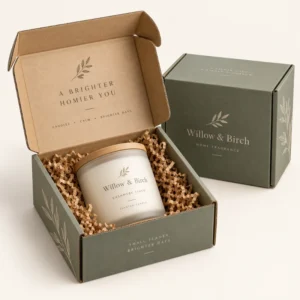
Custom candle packaging boxes are boxes made to the exact size, shape and print of the candle they hold, rather than a generic box that happens to fit. In custom candle packaging boxes, that precision matters, because a box that is too loose lets a jar slide and a label scuff, while a box that is too tight stresses seams and makes packing slow. A well sized box protects the vessel, presents the scent clearly and packs neatly for shops, markets and online orders.
How custom candle packaging boxes are sized to the vessel
Sizing starts with the candle itself, measured at its widest point and at its full height, including any lid, knob, handle or foot. A jar with a wooden lid, for example, is taller and wider than the glass alone, and a pillar with a decorative edge needs clearance that a plain pillar does not. Allow a small gap so the candle slides in without forcing the board, but keep that gap small enough that the candle cannot tip once the lid or tuck flap closes. That balance is the difference between a box that feels tailored and a box that feels approximate.
Weight also shapes size and board choice. A heavy glass jar in a tall, narrow box can become top heavy, while a wider base gives stability on a shelf and in a parcel. For sets, size the box to the group, not to a single candle multiplied, because dividers and spacing change the internal layout. If you compare related formats, custom candle packaging gives the broader design view, while custom candles boxes covers the wider range of candle shapes that share similar box structures.
Box styles for jars, tins, pillars and melts
Tuck end boxes are a practical retail style, because they fold flat for storage, assemble quickly and print well on all panels. Lidded boxes give a stronger gift and premium feel, because the lid lifts to reveal the candle in full. Sleeve and tray boxes give a slim, modern look and work well when a bold band of print or a scent colour needs to stand out. Window boxes let buyers see wax colour, embedded decoration or a label, which helps in shops, but a window reduces protection from dust and light, so it suits candles that will sell quickly rather than sit on a shelf for months.
Tuck end, lidded and sleeve boxes compared
Tuck end boxes suit volume, speed and straightforward retail, lidded boxes suit gifting and premium ranges, and sleeve boxes suit a contemporary range where the tray can be reused or displayed. Many brands use more than one style across a range, with a tuck end box for everyday scents and a lidded box for limited editions and sets. Keeping print layout consistent across styles helps the range read as one family, even when the structure changes.
Internal fit: inserts, dividers and trays
An insert turns a correctly sized box into a secure box. A card insert with a shaped cut out holds a round jar centrally, a cross divider keeps two or three candles apart, and a tray lifts a set into view when the lid opens. Foam inserts suit heavier or unusually shaped vessels, because they cushion and grip, while card inserts suit lighter candles and ranges where recyclability is a priority. Test the insert with the real candle, including its lid, because an insert cut for the jar alone can fail once a lid is added.
When a set needs a different internal layout
Sets need planning for weight balance as well as fit. Place heavier candles centrally or at the base, keep lighter pieces from pressing against glass, and check that the box still closes flat when every piece is in place. A set box that bulges at the lid looks unfinished and can fail in transit, even if each individual candle fits its own compartment. A sample packed with the full set is the only reliable test.
Board, print and finishes for retail sales
Board choice follows sales channel and candle weight. Paperboard gives a smooth, bright print surface for shop display, corrugated board gives cushioning and stacking strength for online delivery, kraft board gives a natural look for handmade ranges, and rigid board gives substance for premium boxes. Print should prioritise scent name and brand mark on the front, with burn guidance and product details on a side panel where they can be read without turning the box inside out. Colour consistency across a range matters, because buyers learn to recognise a scent by its box colour as well as its name.
Finishes should support the brand story, not distract from it. Matte finishes suit calm, natural and luxury ranges, gloss finishes suit bright and photographic artwork, foil suits a logo or scent name that should catch light on a shelf, and embossing suits a botanical or geometric pattern that rewards handling. Inside print can carry a message, a pattern or care guidance, and it is especially effective in lidded boxes, where the inside of the lid is revealed on opening. Keep a clear area for barcodes and delivery labels, so essential codes do not cover artwork or guidance.
Designing for shelves, markets and doorstep delivery
A box designed only for a shelf may fail in a parcel, and a box designed only for a parcel may look plain in a shop. The best compromise is often a strong retail box that travels inside a mailer for online orders, giving display quality plus transit protection. For market stalls, a box that assembles quickly and stacks without toppling saves time and keeps a stall tidy. For subscription orders, a consistent box size helps packing teams work faster and helps customers recognise each delivery, even when scents change.
Labelling and barcode placement
Place barcodes on a flat side panel with good contrast, away from folds and seams, so scanners read them first time. Place delivery labels on the outer mailer rather than on the retail box when possible, so the retail box arrives clean and ready to gift. If a label must go on the retail box, choose a light panel and avoid covering scent names or safety guidance.
Ordering, quantities and lead times
Order planning starts with vessel dimensions, candle type, number of candles per box, board preference, insert type, window or sleeve needs, and artwork status. If you sell singles, pairs and sets, list each format separately, because each needs its own internal layout even if the artwork family is shared. Standard lead times after final artwork approval are 10 to 14 working days, with corrugated options at 12 to 15 working days and rigid or specialist options at 13 to 16 working days. Use those figures as planning guidance, not as a guaranteed delivery date, and allow more time for new artwork, samples and seasonal launches.
Recycling and producer duties are part of ordering too. A right sized, recyclable box reduces waste and postage size, and brands that place packaging on the UK market can check the GOV.UK guidance on extended producer responsibility for packaging for current duties. When you are ready, you can request a quote with your dimensions, and the shop page gives a view of the wider range.
Proofing and sample checks
Proofing should check scent spelling, colour, type size, panel layout, barcode placement and insert fit together, not in isolation. Pack a sample with the real candle, close the box, lift it by the lid or flap, and open it as a customer would. Look for label scuffing, a lid that lifts too easily, a tuck flap that springs open, or a window that shows an unintended part of the candle. Fixing those details before a full run is far simpler than correcting them after boxes reach customers.
What to send with your artwork
Send vessel dimensions, a photo of the candle with its lid on, the number of candles per box, and any safety or burn guidance that must appear. Those details let the box be cut to the candle you actually sell, rather than to a generic size that only approximates it.
Frequently asked questions
How do I measure a candle for a packaging box?
Measure height and widest diameter with the lid on, weigh the finished candle, and note any handle, knob or decorative element. Share those figures and a photo, because a few millimetres can change insert fit and lid closure.
What box style is best for a jar candle?
A tuck end box suits everyday retail, a lidded box suits gifts and premium ranges, and a window box suits shop display where seeing wax colour helps sales. The best style depends on sales channel, weight and how the box will be opened.
Do candle packaging boxes need inserts?
Glass jars and sets benefit most from inserts, because inserts keep vessels centred and apart. Light tins in a very close fitting box may manage without one, but a sample test should confirm that before a full run.
Can I use the same box for different scents?
Yes, if the vessels are the same size. Keep structure and layout consistent and change only scent name, colour or illustration, so the range stays recognisable and reordering stays simple.
How long do custom candle packaging boxes take?
Standard lead times after final artwork approval are 10 to 14 working days, with corrugated options at 12 to 15 working days and rigid or specialist options at 13 to 16 working days. Allow extra time for proofing and seasonal demand.