
custom candle packaging
Showing the single result
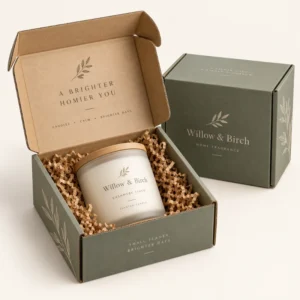
Custom candle packaging is the complete set of choices that protect a candle, present its scent and carry your brand from shelf or packing bench to the customer. In custom candle packaging, the box structure, the board, the insert, the print and the finish each affect how the candle looks, how safely it travels and how easily a buyer can understand what they are buying. When those choices fit the candle itself, packaging stops being an afterthought and becomes part of the product.
What custom candle packaging should do for your brand
Good candle packaging has three jobs, and it must do all three at once. It must protect a product that can be heavy, fragile or easy to dent, it must communicate scent, size and safety guidance clearly, and it must look like it belongs to your brand rather than to any candle on the shelf. A jar candle needs protection for glass, a pillar needs height and stability, a tin needs a close fit that prevents denting, and wax melts need compartments that keep pieces separate and tidy. One generic box rarely does all of those jobs well, which is why sizing and structure matter more than decoration alone.
Think of packaging as a conversation with the buyer. The front panel should answer the first questions: what scent is this, what size is the candle, and who made it. The side or back panel should answer the next questions: how long will it burn, what wax is used, and what care guidance applies. The inside can then add warmth, with a short message or a pattern that rewards opening. If you need format ideas, explore custom candle packaging boxes and custom candle gift boxes to see how a retail box and a gift box differ in structure and mood.
Start with the candle, not the artwork
Measure the candle at its widest and tallest points, including lids, handles, labels that wrap around the vessel and any decorative elements that stick out. Weigh the finished candle, because weight decides board strength, insert type and postage size. Note whether the candle will be sold mainly in shops, mainly online or both, because a shop box can prioritise display and a window, while an online box must prioritise transit protection and a clean opening. Share those facts early in a quote request, because they shape every later decision.
Questions that shape the right specification
Ask yourself where the candle will be seen first, how it will be carried home or delivered, whether it will be given as a gift, and whether it will be stored on a shelf for weeks before use. A candle bought as a gift needs a box that feels complete on its own, while a candle bought for personal use may need a simpler box that is easy to open and recycle. A candle sold in sets needs dividers, while a candle sold singly needs a precise single fit. Answering those questions before artwork begins prevents a beautiful box that fits poorly.
Materials in plain language
Paperboard and cardboard give a smooth print surface, a light feel and a clean retail look, and they suit many jar, tin and pillar candles sold in shops. Corrugated board adds a fluted cushioning layer, which suits online orders, heavier glass and parcels that will be stacked. Kraft board has a natural brown tone and suits handmade, soy and eco focused ranges, while white board gives the cleanest colour reproduction for bright and luxury artwork. Rigid board is thicker and more substantial, and it suits premium ranges where the box itself is part of the luxury experience and may be kept after use.
When to choose rigid board over folding board
Rigid board is worth the extra investment when the candle is premium priced, when the box will be displayed open in a shop, or when the gift experience is central to the sale. Folding board is usually better when you need to store many boxes flat, when you pack large volumes quickly, or when you want a lighter parcel for posting. Both can carry excellent print, so the decision is less about looks and more about weight, handling, storage and the feeling you want the customer to have when they lift the box.
Print, finishes and scent communication
Print should make scent easy to understand. Scent names need to be legible at arm’s length, because a buyer in a shop will scan a shelf quickly and choose by scent first. Colour can support scent, with warm tones for amber and spice, fresh tones for citrus and green notes, and soft tones for floral ranges, but colour alone should never carry the scent message, because buyers interpret colour differently. A clear scent name, a short description of notes, and a consistent layout across a range help buyers find a favourite scent again and try a new one with confidence.
Finishes add texture and hierarchy. Matte lamination softens artwork and reduces glare under shop lights, gloss lamination makes colours richer and suits photographic imagery, foil draws the eye to a logo or scent name, and embossing adds a tactile detail that invites handling. Spot gloss can highlight a single element, such as a botanical illustration or a brand mark, without making the whole box shiny. Use finishes sparingly, because one or two well chosen finishes usually look more premium than a box covered in every available effect.
Labels, safety guidance and legibility
Candle packaging must carry safety and use guidance in a way that buyers can actually read. Keep type large enough for a small box, keep contrast high between text and background, and avoid placing essential guidance over a busy pattern or a photograph. Burn time, wax type and care notes are useful buying information as well as safety information, so give them space rather than squeezing them into a corner. Check a printed proof at actual size, because guidance that looks fine on a large screen can become unreadable once it is reduced to fit a small side panel.
Designing a range, not just a single box
A range works when boxes share structure, layout and brand marks, while scent names, colours and illustrations change. That consistency helps shops display the range as a family, helps online buyers recognise a reorder, and simplifies future artwork, because only the scent panel needs to change. Keep a simple style guide for your own use, noting board, colours, type sizes and panel layout, so a new scent or a seasonal edition does not drift away from the range.
Protection, inserts and sustainable packaging
Protection inside the box is as important as the outer board. A die cut insert holds a jar centrally, a divider separates a set, and a snug fit prevents a pillar rolling. For online orders, consider whether the retail box travels alone or inside an outer mailer, because an inner retail box plus an outer mailer gives two layers of protection and a better unboxing, while a single strong mailer may be simpler and lighter for a single candle. Test both routes with real candles, because a box that looks perfect on a shelf can still let a jar move in a van.
Sustainability should be specific and honest. Recycled board, recyclable structures, paper based void fill and print that avoids unnecessary plastic all help, and a short note explaining how to recycle or reuse the box is more useful than a vague claim. Brands placing packaging on the UK market should also understand producer duties, and the GOV.UK guidance on extended producer responsibility for packaging sets out who is affected and what compliance involves. Choosing a right sized box also reduces waste, because an oversized box uses more board, more fill and more postage space than necessary.
Ordering and lead times
When you request a quote, include candle dimensions and weight, candle type, quantity, board preference, insert needs, print coverage and artwork status. If artwork is not yet final, say so, because proofing and approval affect timing more than production itself. Standard lead times after final artwork approval are 10 to 14 working days, with corrugated options at 12 to 15 working days and rigid or specialist options at 13 to 16 working days. Treat those figures as planning guidance, not as a guaranteed delivery date, and build in extra time for seasonal launches. You can request a quote once you have those details, and the delivery information page can help with planning.
Proofing checklist for candle brands
Check scent spelling, burn guidance, brand marks, colour, insert fit and panel layout on the proof, then pack a real candle in a sample and open it as a customer would. That test catches a label that catches on the insert, a lid that lifts too easily, or text that is too small, all before a full run is printed.
Frequently asked questions
What is included in custom candle packaging?
Custom candle packaging usually includes the box structure, board choice, print, finish and insert, all sized to your candle. It may also include a sleeve, window or outer mailer, depending on whether the candle is sold in shops, online or as a gift.
Which material is best for candle packaging?
Paperboard suits light candles for display, corrugated board suits online orders and heavier glass, kraft board suits natural ranges, and rigid board suits premium gift ranges. The best choice depends on candle weight, sales channel and the feeling you want the box to give.
Can one packaging design work for a whole scent range?
Yes, if the structure and layout stay consistent while scent names and colours change. That approach keeps the range recognisable, simplifies reorders and makes it easier for buyers to find a favourite scent.
Do I need an insert in candle packaging?
An insert is advised for glass jars, sets and any candle that could move inside the box. It protects labels and lids, keeps the candle centred and improves the opening experience.
How long does custom candle packaging take?
Standard lead times after final artwork approval are 10 to 14 working days, with corrugated options at 12 to 15 working days and rigid or specialist options at 13 to 16 working days. Allow extra time for artwork, proofing and seasonal demand.