
buy mailer boxes
Showing the single result
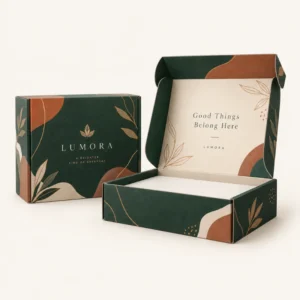
To buy mailer boxes is to choose a folding corrugated box that protects a product in the post and presents it well when the customer opens it. Mailer boxes are popular with online shops, makers and small brands because they pack quickly, store flat and can carry print inside and outside. The right mailer box balances size, board strength, closure style and print, so it survives handling without looking plain or over packaged.
How to Buy Mailer Boxes
Start with the product, not the box catalogue. Measure the product as it will travel, including any tissue, sleeve, bottle box or protective wrap, and note its weight and fragility. A clothing item folded in tissue needs a very different internal depth from a candle in a protective insert or a set of cosmetics in individual cartons. That packed measurement, plus a small clearance for easy insertion, is the internal size to work from.
Next, think about how the box will be used at the packing bench. A box that folds in three or four moves and locks without tape will pack faster than a box that needs careful taping on every seam. Speed matters when orders build up, but speed should not come at the cost of security. Test a sample with the heaviest product it will carry, and check that the lock holds when the box is lifted, turned and stacked.
Mailer Styles Explained
Mailer boxes are made in several styles, each with a different opening experience. A tuck style mailer uses flaps that tuck into the front panel and gives a clean, simple opening. A tab lock style uses tabs that slot firmly into place and gives a more secure closure for slightly heavier items. A crash lock base folds into place with a push and is useful when packing speed is a priority. A hinged lid style opens like a gift box and suits presentation led products where the reveal matters.
Choosing a Closure for Your Products
Light, soft products such as folded clothing, scarves and printed matter often suit a tuck style closure, because the contents are not heavy and the box is easy to open. Heavier or more valuable products may suit a tab lock closure, because it resists opening in transit. Fragile products may need tape in addition to a lock, especially if the parcel will travel through several sorting stages. The closure should match the risk, not just the appearance, of the box.
Uses Across Different Products
Clothing sellers use mailer boxes to present folded garments neatly, often with tissue and a printed inside lid message. Cosmetics sellers use mailer boxes to hold bottles and jars apart, with inserts that stop glass items knocking together. Candle makers use mailer boxes with snug inserts that protect wax and glass while presenting scent and branding clearly. Book and stationery sellers use mailer boxes to protect corners and covers, which are the first parts to show damage.
Food and gift sellers also use mailer boxes, but they should consider inner packaging carefully. A mailer box alone does not make a product food safe, and any food contact packaging inside the box must be suitable for its purpose. For gift sets, a mailer box with a fitted insert can hold several small items in a planned layout, so the recipient sees the set as a whole rather than a collection of loose pieces.
Materials, Board and Print for Mailer Boxes
Most mailer boxes use corrugated board, which gives strength without excessive weight. Kraft board gives a natural brown look and suits brands that want a simple, earthy presentation. White board gives a clean surface for bright print and suits brands that rely on colour accuracy. Both boards can be printed, but colour will appear differently on each, so check a printed sample on the chosen board before approving a large run.
Board thickness and flute affect both protection and print quality. A finer flute gives a smoother print surface and a neater fold, which suits presentation led mailer boxes. A coarser flute gives more cushioning and suits heavier or more fragile contents. Discuss the product and journey with the supplier, because the best board is the one that matches real handling, not just the lightest board that can be folded into shape.
Print Inside and Outside
Outside print is what the customer and courier see first. A logo, a brand colour or a simple pattern can make a parcel recognisable and reduce the chance of it being mistaken for generic mail. Inside print is what the customer sees on opening. A short message, a care guide, a pattern or a discount reminder printed on the inside lid can turn a routine delivery into a memorable moment without adding loose inserts.
Finishes and Colour Accuracy
Finishes such as matt lamination reduce glare and fingerprints, which helps when customers photograph their delivery. Gloss lamination can lift bright colours and give a polished feel. Foil and embossing suit logos and titles in small areas, but they should not compete with the main design. For colour accuracy, supply artwork carefully and check proofs on the chosen board, because kraft board will soften bright colours while white board will keep them brighter and cleaner.
Sizes and Measuring Advice
Always measure internal dimensions. External dimensions include board thickness and can mislead a buyer by several millimetres, which matters for a snug product. Measure length, width and depth inside the finished box, then compare with the packed product size. Allow a small clearance so the product can be inserted and removed without forcing, and use an insert or void fill to stop movement if the product is smaller than the box in one dimension.
If one mailer box will serve several products, design around the largest product and use tissue or an insert to adapt the box for smaller items. Holding one versatile size is often simpler than holding many sizes that each move slowly. It also simplifies stock control and packing training, because staff learn one fold and one packing routine.
Ordering, Lead Times and Packing Tips
When you are ready to order, share the internal size, product weight, quantity, print needs and artwork stage. If artwork is not finished, the supplier can still advise on size and structure while design work continues. If you need a sample, pack it with real products and test the fold, lock, print and opening experience. A sample test is the best way to catch a size or closure problem before a full order is produced.
After final artwork approval, standard boxes are usually produced in 10 to 14 working days and corrugated boxes in 12 to 15 working days. Those timings are production guides, not guaranteed delivery dates, so allow extra time for delivery to your premises and for packing tests. For a launch or seasonal peak, order earlier than the production guide alone suggests, because packing, labelling and courier collection also take time.
Packing for a Good Opening
Packing order matters for presentation. Place the main product where it will be seen first, then supporting items around it in a logical order. Use tissue to protect surfaces and to add a sense of care, but avoid so much tissue that the product is buried or difficult to find. Place any printed card or note where it will be seen without hiding the product, such as on top of tissue or inside the lid.
Storage and Repeat Orders
Store flat packed mailer boxes in a dry place, stacked neatly and labelled by size and design. Keep a record of the agreed specification, including board, size, print files and closure style, so repeat orders match the first run. That record also helps when a product range changes slightly, because the supplier can advise whether an existing box still fits or whether a new size is needed. For related packaging, see bulk mailer boxes, buy custom shipping boxes and request a quote for mailer boxes.
Frequently asked questions
What are mailer boxes?
Mailer boxes are folding corrugated boxes that protect products in the post and present them well on opening, with print possible inside and outside.
How do I buy mailer boxes in the right size?
Measure the product as packed, including tissue or an insert, then choose internal dimensions with a small clearance so the item fits without rattling or pressure on the lid.
What is the difference between tuck and tab lock mailer boxes?
A tuck style mailer uses flaps that tuck into the front panel for a simple opening, while a tab lock style uses tabs that slot firmly into place for a more secure closure.
Can mailer boxes be printed inside?
Yes, many mailer boxes carry print on the inside lid, which can show a message, a pattern or a care guide when the customer opens the box.
How long does production take after artwork approval?
Standard boxes are usually produced in 10 to 14 working days and corrugated boxes in 12 to 15 working days after final artwork approval. These are production guides, not guaranteed delivery dates.
Are mailer boxes recyclable?
Cardboard mailer boxes can usually be recycled with paper and card collections in the UK, depending on local rules and on any lamination or mixed materials used.