
Custom Mailer Box Sizes UK: How to Choose the Right Size for Your Product
Custom mailer box sizes UK businesses need should be chosen from the packed product outwards, not from a supplier’s size list inwards. Measure the product as it will actually ship, include any…
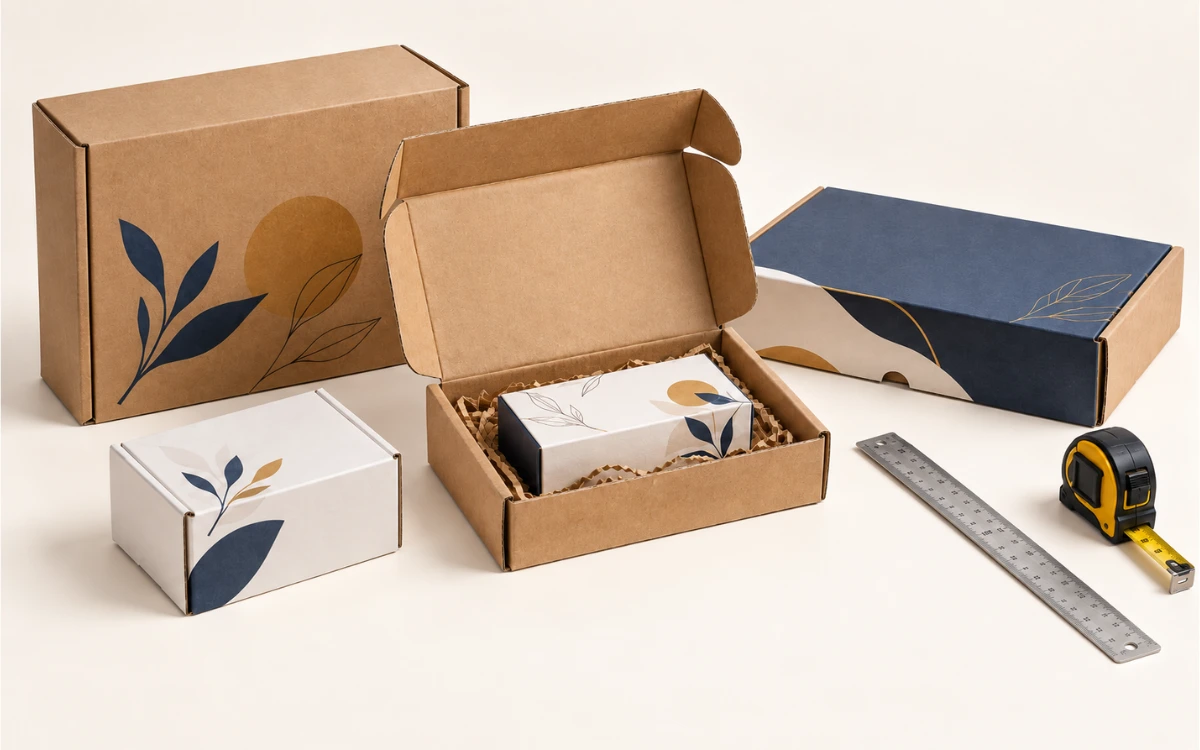
Custom mailer box sizes UK businesses need should be chosen from the packed product outwards, not from a supplier’s size list inwards. Measure the product as it will actually ship, include any insert, tissue, sleeve or protective packaging material, then specify the internal box space you need. After that, check the finished external dimensions and packed weight against the delivery service you intend to use.
Start with the packed product, not the bare product
The most useful measurement is the size of the item in its real shipping configuration. A candle in its retail carton is larger than the candle itself. A skincare bottle held in a die-cut insert occupies more space than the bottle diameter suggests. Folded clothing can compress, while a boxed electronic accessory may need clearance around rigid corners.
Measure the longest dimension as length, the shorter face dimension as width, and the vertical dimension as height or depth. Keep the order consistent throughout the quotation, dieline and approval process so that nobody swaps width and depth later.
If the product needs tissue, padding, a sleeve, dividers or an insert, include those components before finalising the mailer size. The box is being designed around the packed unit, not around a catalogue measurement.
Internal and external dimensions solve different problems
Internal dimensions tell you whether the product and its protection will fit. External dimensions tell you how much space the finished parcel occupies.
That distinction matters for postal sizing. A box can have an internal depth that appears to fit a postal limit while its finished external depth exceeds it once corrugated board, folds and closure panels are taken into account.
FEFCO Recommendation 101 explains that material grade, flute form and case style influence the creasing allowance used when determining corrugated-case dimensions. For that reason, a finished box should not be assumed to match its nominal internal dimensions externally.
For quoting, state clearly whether the dimensions you provide are internal or external. For postage, measure the assembled, closed and packed box from the outside.
A practical five-step method for choosing a mailer box size
1. Measure the product in its shipping configuration
Arrange the product exactly as it will sit in the parcel. For a multi-item order, build the intended set rather than adding individual dimensions on paper. Measure the outermost points of the packed arrangement.
If the product changes shape under light pressure, such as folded clothing, decide how much compression is acceptable before measuring. Consistency matters more than forcing the smallest possible number.
2. Decide how the product will be restrained
A snug box does not automatically mean a protected box. Fragile products may need cushioning. Bottles may need an insert that controls side-to-side movement. A presentation set may need compartments so that products arrive in the same layout the customer was meant to see.
Choose the protection method before the final box dimensions. Otherwise, the insert or void fill becomes an afterthought and can push the box beyond the size you ordered.
3. Add functional clearance, not arbitrary empty space
There is no single clearance figure that suits every mailer box. The right allowance depends on the product, board construction, insert, packing method and how easily the item must be loaded.
A rigid retail carton may need only enough working room to load without scuffing. A glass jar with cushioning needs more space because protection performs a physical job. A soft garment behaves differently again.
Instead of copying a universal “add X millimetres” rule, define the packed configuration first. Where practical, make a structural sample and check that staff can pack it consistently without forcing the product or leaving avoidable movement.
4. Convert the required space into an internal box specification
Once the packed product and protection are settled, specify the required internal length, width and depth. The packaging supplier can then develop the dieline and structural allowances around that usable space.
This is the point to consider whether a standard size is genuinely close enough or whether custom mailer boxes avoid unnecessary void space. A stock box can be sensible when the fit is good and order volumes are modest.
A custom size becomes more useful when fit, postage bands, inserts, presentation or repeated fulfilment justify tighter control.
5. Check the finished parcel against the delivery method
Do not stop at the internal size. Assemble the box, add the real product and protection, close it as it will be dispatched, then measure the outside and weigh the complete parcel.
That final check is especially important when the pack sits near a carrier threshold. A few millimetres of extra external depth can change the service category even though the product still fits perfectly inside.
Royal Mail size limits worth checking before you order
For Royal Mail 1st and 2nd Class, the currently published maximum dimensions and weights include the following:
| Format | Maximum dimensions | Maximum weight |
|---|---|---|
| Large Letter | 353 × 250 × 25 mm | 750 g |
| Small Parcel | 450 × 350 × 160 mm | 2 kg |
| Medium Parcel | 610 × 460 × 460 mm | 20 kg |
These are maximum finished parcel limits, not suggested internal mailer dimensions. If a mailer is intended to qualify for one of these formats, check the assembled external box and final packed weight rather than designing the internal cavity to the maximum figure.
It is also sensible to leave practical manufacturing and packing tolerance instead of aiming for a finished parcel that only just meets a carrier limit.
If another courier or fulfilment service will be used, check that provider’s current rules separately because size and volumetric-weight policies are not universal.
Why “standard mailer box sizes” are only starting points
Suppliers often present small, medium and large mailer dimensions as convenient ranges, but those labels are not universal UK dimensional standards. Different suppliers can use different measurements for products described with the same general size name.
When comparing custom mailer box sizes UK suppliers list, use a stock size as a comparison point rather than proof that the size suits your product.
The useful questions are more specific. Does the packed item fit without pressure? Is movement controlled? Can the box be packed efficiently? Does the final parcel stay within the delivery limits that matter to the order?
This approach also avoids a common purchasing mistake: choosing a box because its length and width look right while ignoring depth.
For Large Letter in particular, thickness is tightly constrained. Royal Mail currently specifies a maximum Large Letter depth of 25 mm, so the finished external depth can become the deciding measurement.
How inserts and presentation choices change the required size
An insert can improve presentation and restraint, but it also consumes internal volume. The effect depends on the insert style and on whether products sit beside each other, in separate cavities or on different levels.
Plan the product layout and insert together. If the insert is designed after the box, the designer may have to reduce material around the product, increase the box size or compromise the intended presentation.
The same principle applies to tissue and decorative fill. They may be visually light, yet they still need room to sit without bulging the lid or placing pressure on the contents.
A mailer that closes only when the packer compresses everything by hand is too dependent on technique for repeatable fulfilment.
For products that need greater control inside the box, the mailer and insert should normally be specified as one structural system rather than as a box plus an accessory chosen later.
Board choice can affect the finished dimensions
Corrugated cardboard boxes are not dimensionless shells. Board construction, flute form, material grade, folds and creasing allowances influence the finished structure.
FEFCO’s dimensional guidance for corrugated cases explains the relationship between case measurements and creasing allowances used to obtain the required internal dimensions.
That matters most when dimensions are tight. Changing board specification after approving the size can alter how the box folds, how much internal room is available and how close the external parcel sits to a postal limit.
If the box has to fit a product closely or remain within a strict delivery format, approve size and board together.
Choosing sizes for several products without creating too many boxes
A growing ecommerce range can easily end up with a separate box for every SKU. That may reduce empty space, but it can make storage, purchasing and packing more complicated.
A better approach is to group products by packed footprint and protection requirement. One mailer might serve several lightweight products that share a similar height. Another may be reserved for sets that need an insert. A third may cover larger multi-item orders.
The aim is not to minimise the number of box sizes at any cost. It is to avoid both extremes: too many near-duplicate sizes that slow operations, and too few oversized boxes that create excess void space.
Test the proposed range against real orders, including common bundles rather than single SKUs only.
Product-specific sizing priorities
| Product type | Sizing priority | What to check before approval |
|---|---|---|
| Folded clothing | Controlled depth without excessive compression | Fold method, tissue, returns presentation and packed external depth |
| Cosmetics and skincare | Product restraint and upright or side orientation | Caps, pumps, retail cartons, insert cavities and fragile components |
| Candles and jars | Protection against movement and impact | Cushioning thickness, lid clearance and separation between items |
| Printed goods | Low external thickness and corner protection | Finished stack thickness, bend protection and postal format |
| Subscription or gift sets | Repeatable multi-item layout | Largest intended combination, insert layout and presentation order |
| Small electronics and accessories | Rigid edges and movement control | Retail packaging, cables, chargers, inserts and surface protection |
The table is a decision guide, not a list of fixed dimensions. Two products with the same nominal size can need different boxes because their fragility, retail packaging and presentation requirements differ.
Common mailer box sizing mistakes
The first mistake is measuring the bare product and adding protection later. That often produces a box that technically closes but is awkward to pack.
Another is confusing internal dimensions with postal dimensions. Carrier limits apply to the finished parcel, so the outside measurement is the relevant one at dispatch.
Oversizing also causes problems. Extra room can mean more material, more void fill and more movement inside the box. For businesses using additional packaging materials, a better-fitting mailer may also reduce how much cushioning or void fill is needed.
At the other extreme, making a box too tight can scuff retail cartons, deform soft goods, place pressure on pumps or caps, and make packing slower. The smallest possible box is not automatically the most efficient box.
Finally, do not approve a size from numbers alone when the product is fragile, unusually shaped or close to a postal threshold. A plain structural sample can reveal loading and closure problems before printed production begins.
A sizing checklist before approving a dieline
- Dimensions are labelled clearly as internal or external.
- The product was measured in its real shipping configuration.
- Inserts, tissue, sleeves and protective materials are included.
- The item can be loaded and removed without forcing it.
- Movement is controlled to a level appropriate for the product.
- The chosen board specification matches the approved structure.
- The assembled parcel has been measured externally.
- The final packed weight has been checked.
- The intended Royal Mail or courier limits have been rechecked from the carrier’s current guidance.
- Common multi-item orders have been tested, not only the smallest single item.
A sample is particularly valuable when a few millimetres affect fit, closure or postage classification.
FAQs about custom mailer box sizes UK businesses use
What size should a mailer box be compared with the product?
The box should provide enough internal space for the product in its real shipping configuration, including any insert or protective material, without creating unnecessary movement.
There is no universal extra allowance that suits every product. Rigid, fragile, soft and multi-item products need different clearances.
Are mailer box dimensions internal or external?
Packaging quotations often use internal dimensions because they describe usable space, but you should confirm this with the supplier.
For postage, measure the finished parcel externally. FEFCO Recommendation 101 also explains a procedure for determining internal dimensions of corrugated cases.
What is the maximum Royal Mail Large Letter size?
Royal Mail currently lists Large Letter at up to 353 mm long, 250 mm wide and 25 mm deep, with a maximum weight of 750 g. Measure the finished, closed parcel rather than using those figures as the internal dimensions of a mailer box.
What is the maximum Royal Mail Small Parcel size?
Royal Mail currently lists a Small Parcel at up to 450 × 350 × 160 mm and 2 kg. If your box is close to any limit, check the final packed external dimensions against the latest Royal Mail size guidance before dispatch.
Should I choose a standard size or a custom mailer box?
Choose a standard size when it fits the packed product well and does not create unnecessary operational or postage problems.
Choose a custom mailer box when product fit, presentation, inserts, repeated packing efficiency or delivery limits make tighter dimensional control worthwhile.
Do inserts change the box size I need?
Usually, yes. An insert occupies space and can change how products are arranged, so it should be considered before the box size is finalised.
Designing the insert and mailer together gives you a better chance of controlling movement without making the box larger than necessary.
Choose the size from the fulfilment reality
The right mailer size is the one that works after the product, protection, insert, board and delivery method are considered together. Start with the packed item, define the required internal space, then verify the finished external parcel.
If standard options still leave too much empty space or do not suit your product layout, Personalized Mailer Boxes can help specify custom mailer boxes around the packed dimensions of your product, with free design support and flexible low-MOQ options where appropriate.
Planning Your Next Custom Mailer Packaging Project?
Personalized Mailer Boxes is a specialist Vertex Packaging project. Get practical support with box structure, dimensions, board, print, inserts and finishing for your next UK packaging order.