
mailing box custom
Showing the single result
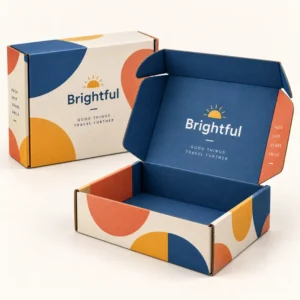
A mailing box custom made for your product is a postal box designed around your size, your artwork and your brand, rather than chosen from a fixed stock size. It can be printed inside and outside, fitted with an insert for the exact contents, and finished to suit the impression you want the customer to receive. For a business with a distinctive product or a strong visual identity, a custom box turns posting from a purely practical task into a deliberate part of the brand experience.
What a mailing box custom design includes
A custom design starts with structure. The printer will consider how the box folds, how it closes, how it stacks and how it will be opened by the customer. A tuck in lid suits a clean, simple parcel, while a lid with a tear strip suits a box that should open quickly without tools. Dust flaps add protection at the corners, and a well placed closure can also act as a tamper evident feature for higher value contents. These structural choices matter as much as print, because a beautiful box that is awkward to pack or open will frustrate both staff and customers.
Size is the next decision, and it should be driven by the product plus its protection. Measure the product in its wrap, consider any insert, and allow enough room for the item to be placed inside without pressure on the flaps. A custom size removes the compromise of a stock box that is too large or too tight, and it can reduce void fill, improve stacking and give a tidier appearance. If you send several versions of a product, a single custom size that fits the largest version, with an insert for smaller versions, can be more practical than several separate boxes.
From idea to dieline
The dieline is the flat template that shows every panel, fold, glue area and bleed zone for your box. Designers work to this template so artwork lands exactly where intended, and so text and logos avoid folds that would distort them. If you have an existing logo or pattern, share the original artwork files where possible, because a high resolution file will print far more cleanly than a small image taken from a website. If you do not have print ready artwork, describe the look you want and ask what support is available for preparing the design.
Artwork checks before approval
Before approving a proof, check spelling, contact details and any instructions printed on the box, because these are easy to overlook when focusing on colour and layout. Check that the logo is sharp, that colours match your brand as closely as board and print allow, and that the delivery label area remains clear. View the proof at actual size where possible, and ask for a physical sample for a high value or high volume run, so you can test the fold, the closure and the feel of the board in hand.
Materials for a mailing box custom order
Board selection shapes both protection and appearance. A fine flute corrugated board offers a good balance of strength and print quality for most posted products, while a heavier board suits larger or more fragile items. Kraft board gives a natural tone and a tactile surface that works well for craft, food and lifestyle brands, while white board gives brighter whites and more vivid colour for bold designs. The finish can then refine the result, with matt giving a soft premium feel and gloss giving deeper colour and extra scuff resistance.
Think about the full journey when choosing board. A box that travels through sorting centres, vans and doorsteps needs to resist compression and corner knocks, not just look good in a photograph. If the contents are fragile, a stronger board plus a fitted insert will usually protect better than a lighter board plus a large amount of loose void fill. If the contents are light and robust, a lighter board can reduce weight and material use while still presenting the brand well.
Print, colour and brand consistency
Colour consistency is a common concern for custom orders, because board absorbs ink differently from coated paper. Ask how colours will be reproduced, whether a proof will show the expected result on your chosen board, and whether a spot colour is advisable for a critical brand colour. Keep the design system simple across the box, the insert and any card inside, using the same palette and type style, so the whole pack reads as one coherent piece rather than a collection of separate prints.
Using the inside of the box well
The inside of a custom box is valuable space that many brands leave blank. A short message can thank the customer, explain how to use or care for the product, or invite a review in a natural way. A pattern can add delight without words, and a simple diagram can help with assembly or returns. Keep interior text short and legible, because the customer will see it for only a few seconds, and make sure it does not compete with the main exterior branding.
When a custom mailing box is worth it
A custom box is worth considering when a stock size forces a compromise, when the product has an unusual shape, or when the unboxing is part of the value you sell. It is also worth considering for launches, collaborations and gift editions, where the packaging helps tell a story that a plain box cannot. For a business sending only occasional parcels, a plain printed box may be sufficient, but for a brand that posts regularly, the consistency and presentation of a custom box can repay the planning time many times over.
Custom work also helps when you need a box to do a practical job beyond protection. Examples include a box with compartments for a set, a box with a window or cut out for a product reveal, and a box designed to be kept and reused by the customer. In each case, the structure should be tested with the real contents, because a clever idea on paper can fail if the insert is fiddly or the closure is weak. A prototype, even a plain one, is a wise step before committing to print.
Planning quantities and reorders
Quantities should reflect real posting volumes, storage space and the risk of artwork changes. Ordering too few can mean a second run sooner than planned, while ordering too many can tie up space and cash if the product or branding changes. Keep the dieline, artwork files and specification on record, so a reorder can match the original exactly. That record also helps if you later add a second size or a seasonal version, because the new box can be designed to sit naturally alongside the original.
Ordering a mailing box custom design on a quote basis
Custom boxes are supplied on a quote basis, because size, board, print, finish and quantity all shape the specification. Share product dimensions, contents, artwork notes and expected quantities, and the team can advise on structure and board. Standard lead times after final artwork approval are 10 to 14 working days, corrugated options are 12 to 15 working days, and rigid or specialist options are 13 to 16 working days. These are production times after approval, not a guaranteed delivery date. You can request a quote for a mailing box custom design, read the delivery information page, see related mailing boxes custom options, or start from Personalized Mailer Boxes.
Frequently asked questions about a mailing box custom design
What does a mailing box custom order mean
It means the box size, structure, artwork and finish are made for your product and brand, rather than selected from a fixed stock range. You provide dimensions and artwork, a dieline and proof are prepared, and production follows your approval.
Do I need print ready artwork to order
Print ready artwork helps, but it is not always essential at the first enquiry. Share the best files you have, describe the look you want, and ask what design support is available before the proof stage.
Can a custom mailing box include an insert
Yes, an insert can be designed to fit the exact contents, from a simple divider to a shaped fitment. Designing the insert with the box helps keep internal dimensions correct and the presentation tidy.
How long does production take after artwork approval
Standard lead times after final artwork approval are 10 to 14 working days, corrugated options are 12 to 15 working days, and rigid or specialist options are 13 to 16 working days. Allow extra time for proofing and posting.