
large shipping boxes
Showing the single result
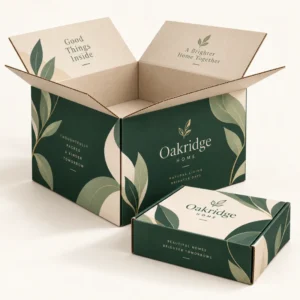
large shipping boxes are built for orders that need real room and real strength, from multi item parcels and bulky homeware to business stock and subscription kits. They protect heavier contents through handling, stacking and courier journeys, and they can be printed with your branding so a large parcel still looks considered on arrival. The right box balances internal space, board strength and a secure closure, so the contents arrive in the condition your customer expects.
What large shipping boxes are used for
Large shipping boxes suit any order where a standard postal box would be too small or too weak. Typical uses include clothing bundles, bedding, shoes in pairs, homeware, toys, hampers, books in sets, and business to business stock sent in one parcel. They also suit subscription boxes that combine several products, because one larger box can replace multiple small parcels and give a cleaner unboxing experience.
Think about the full journey, not just the first packing step. A large box may be stacked under other parcels, carried by a handle free side, placed on a doorstep, or opened and resealed for a return. Board strength, a firm base and a seal that stays closed all matter more at this size, because a failure affects more product at once.
Large shipping boxes for multi item orders
Multi item orders need space for each product plus protection between items. Use dividers, tissue or paper fill to stop items moving and rubbing, and place heavier items at the base so lighter items are not crushed. A box that is deep enough for the tallest item, with room for a top layer of protection, will travel better than a box that is packed tight to the lid.
Packing a multi item box well
Start with a layer of protection at the base, add the heaviest items first, fill gaps as you go, and finish with a top layer that stops movement when the lid closes. Seal with strong tape along the centre seam and across the ends if the box is heavy. Label clearly on the largest flat face so the parcel is easy to scan and handle.
Board strength and construction in large shipping boxes
Corrugated board is the usual choice for large shipping boxes because it gives strength at a manageable weight. Single wall board suits light bulky items such as soft furnishings or clothing, while double wall board suits heavier goods, stacked parcels and items that need extra crush resistance. The flute profile affects cushioning and stacking strength, so describe the product weight and the expected stacking when you ask for a recommendation.
Construction details also matter. A regular slotted carton with taped flaps is simple and reliable for most orders, while a mailer style box with a self locking lid gives a neater opening for customer facing deliveries. For very heavy items, check the base construction and consider a box with a reinforced base or an inner tray that spreads the load.
Printed large shipping boxes for brand impact
A large box is a large canvas, so print has a strong effect. A logo, brand colour, simple pattern or message on the outside makes the parcel recognisable, while print inside the lid adds a surprise when the box is opened. Keep the main branding away from the label area, and make sure handling instructions remain legible if you use them.
Design tips for a large printed box
Use bold, simple artwork that reads well at a distance, and avoid fine detail that may lose clarity on kraft board. Ask for a proof, check colours on the actual board colour you will use, and confirm that the design works when the box is folded, because artwork near a fold or seam can distort. Once final artwork is approved, standard lead times are 10 to 14 working days, corrugated orders are 12 to 15 working days, and rigid or specialist orders are 13 to 16 working days.
Choosing the right size for large shipping boxes
Choosing a size starts with the largest product you will send in that box, measured after wrapping. Add space for protection and for any insert, then test the packed box for movement. A box that allows a small amount of fill is better than a box that forces you to compress a product, and it is also better than a very large box that needs a lot of void fill to stop movement.
Storage is a practical factor too. Large boxes take up more warehouse space, even when flat, so a range of two or three sizes that covers most orders is usually more efficient than a wide range of rarely used sizes. Review order data, group products by packed size, and choose sizes that match those groups.
Large shipping boxes and carrier limits
Each carrier sets its own limits for length, girth, weight and handling, and large boxes are more likely to approach those limits. Check the limits for the service you use, weigh a sample packed parcel, and measure the sealed box before you commit to a size. A box that is slightly smaller but still protective can avoid surcharges and handling problems, while a box that is too large may be harder to store, carry and deliver.
For Royal Mail parcels, the maximum parcel size shown in the Royal Mail business shipping guide is a useful reference, but courier limits differ, so confirm the service you will actually use. If you send a mix of Royal Mail and courier parcels, you may need two box ranges, one for each route.
Reducing damage in large parcels
Damage in large parcels often comes from movement, stacking pressure or a weak seal, rather than from the board alone. Fill voids, tape fully, avoid overfilling, and do not rely on the outer box to protect fragile items without inner protection. For glass, ceramics or electronics, add a fitted insert or extra cushioning around each item.
Ordering large shipping boxes on a quote basis
Large shipping boxes are supplied on a quote basis because board grade, size, print and quantity all change the specification. Share the packed dimensions, the product weight, the quantity and the print requirement, and you will receive a recommendation that fits the order rather than a generic size. If you also need a smaller postal option for flat items, compare large postage boxes alongside this range.
You can browse the full range in the shop, learn more on the about us page, check the delivery information page, or start a request through get a quote.
Frequently asked questions
What is the difference between large shipping boxes and large postage boxes?
Shipping boxes are generally deeper, stronger and suited to bulky or heavy orders, while postage boxes are often slimmer and suited to flat items. Choose by packed size, weight and carrier limits, not by the name alone.
Should I choose single wall or double wall board?
Single wall board suits light bulky items, while double wall board suits heavier goods and parcels that will be stacked. Describe the product weight and journey when you ask for a recommendation.
Can large shipping boxes be printed?
Yes, they can carry a logo, brand colours or full artwork on the outside, inside the lid, or both. Keep the label area clear and check a proof on the board colour you will use.
How do I stop items moving inside a large box?
Use dividers, paper fill or fitted inserts, place heavy items at the base, and fill gaps so nothing shifts when the box is turned. A top layer of protection also helps when the lid closes.
How long do custom orders take?
After final artwork approval, standard orders take 10 to 14 working days, corrugated orders take 12 to 15 working days, and rigid or specialist orders take 13 to 16 working days. These are guides, not guaranteed dates.