
kraft packaging boxes
Showing the single result
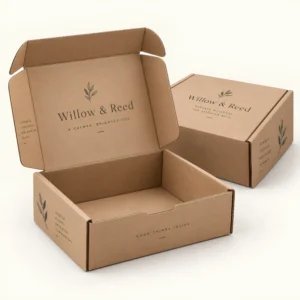
kraft packaging boxes are boxes made from natural brown kraft board or corrugated kraft board, designed to protect, present and store products for posting, retail and everyday business use. They are chosen when a business wants a box that is strong enough for transit, clear enough for labelling and simple enough to print with a logo or product information. A well specified kraft packaging box keeps its shape under stacking, closes cleanly and arrives in a condition that reflects well on the sender.
What kraft packaging boxes do in a business
A packaging box has several jobs at once. It must contain the product, protect it from knocks and crushing, carry a label that can be read and scanned, and, where relevant, present the product well on opening. Kraft packaging boxes meet those jobs with a paper based material that is familiar to couriers, easy to tape and label, and widely accepted in paper recycling where local collection allows it and finishes are kept simple.
Businesses use kraft packaging boxes for online orders, wholesale shipments, gift sets, sample packs, storage and returns. The same basic material can serve a small maker posting a few orders a week and a larger seller posting daily, because size, board strength and print can be adjusted to the volume and the product. That flexibility is one reason kraft boxes remain a default choice even as other packaging materials come and go.
Box styles that fall under kraft packaging boxes
Regular slotted cartons are the familiar taped box with four flaps, suited to general shipping and storage. Mailer boxes have a tidy lid and are suited to presentation and direct posting. Tuck end cartons have flaps that tuck into the ends and are suited to lighter retail products such as soap, stationery and small cosmetics. Die cut boxes are cut to a specific shape and can include a fitted lid, a handle cut out or a display window area, although a window changes the material mix and should be considered carefully.
Each style has a different packing rhythm. A regular slotted carton is fast to tape and stack, a mailer is fast to close and open, and a tuck end carton is neat on a shelf but less suited to heavy postal loads on its own. Choosing the style that matches the main use, rather than the style that looks most attractive in isolation, usually gives the best result in daily use.
Single wall, double wall and board flutes
Single wall corrugated board has one fluted layer between two liners and suits light to medium weight goods. Double wall board has two fluted layers and suits heavier, fragile or stacked goods. E flute board is thinner and smoother, which helps print quality, while B flute board is thicker and gives more cushioning. C flute board is thicker still and is often used for general shipping cartons. The right combination depends on product weight, stacking height and how far the parcel will travel.
Choosing kraft packaging boxes by product and journey
Start with the product and its weakest point. A jar needs protection against impact and a snug fit to stop rolling. A folded garment needs a box that prevents creasing and keeps the garment flat. A set of items needs dividers or an insert to stop items knocking together. A heavy item needs a stronger board and a tape pattern that supports the base. A light item in a large box needs void fill, which is a sign the box is too large.
Then consider the journey. A parcel posted on its own needs a stronger closure and a label area that stays flat. A parcel sent in bulk to a retailer may need stacking strength more than presentation. A box used for storage needs a lid or flaps that close repeatedly without weakening. A box used for returns needs to survive opening and resealing. Matching the box to the journey prevents the common problem of a beautiful box that fails in the post, or a strong box that looks out of place in a gift set.
Measuring for a good fit
Measure length, width and height of the packed product, including wrap, tissue or an insert. Compare those figures with internal box dimensions, not external dimensions alone. Allow a small clearance for easy packing, but avoid a large gap that allows movement. For fragile goods, allow room for cushioning on all sides, not only on the top. For flat goods, choose a shallow box that holds the product flat rather than a deep box that allows folding or bending.
A packed sample is the best test. Pack the product exactly as you would for a real order, close the box, tape it as you would for posting, and check for bulging, movement and label placement. Stack filled boxes to check crushing, and open the sample to check whether the product is still in place. Those checks take minutes and can prevent damage across many orders.
Storage, stacking and handling in a workspace
Flat packed kraft boxes save storage space and are easy to assemble when needed, but they must be kept dry, flat and away from heavy items that could crease the board. Assembled boxes should be stacked with heavier boxes at the bottom and lighter boxes at the top, with flaps fully closed to support the load. Clear labelling of box sizes in a workspace reduces packing errors, especially when several similar kraft boxes are in use at once.
Printing and labelling kraft packaging boxes
Print on kraft packaging boxes should be legible first and decorative second. A brand name, a logo and a short handling note are often enough. Dark inks print boldly on brown kraft, while pale inks may need a white base. Keep the label area free of heavy print, so the address and barcode remain clear. If the box will carry a barcode for internal stock control, test scanning on a kraft sample, because contrast on brown board can differ from contrast on white board.
For presentation focused formats, see kraft mailer boxes and for a broader material overview see kraft packaging. Using a consistent print style across those ranges helps a brand look coherent, even when different box styles are used for different products.
Ordering and lead times
Share product dimensions, weight, quantity, board needs and print requirements when you ask for a quote. After final artwork approval, standard boxes are typically produced in 10 to 14 working days, corrugated boxes in 12 to 15 working days, and rigid or specialist boxes in 13 to 16 working days. Those figures are production lead times, not guaranteed delivery dates, so confirm the full timeline for your order before planning a launch or a busy sales period.
All boxes from this site are quote only, so no price is stated on this page. To start, request a quote with a short product description and the box style you have in mind. If you are unsure which style suits your product, describe the product and its journey, and the quote can be based on that practical brief rather than a style name alone.
Recycling and disposal notes
Uncoated kraft packaging boxes are widely recyclable through paper recycling where local collection accepts corrugated board. Remove tape and labels where local guidance asks for that, and keep plastic inserts separate where possible. For business packaging duties in the UK, see GOV.UK guidance on extended producer responsibility for packaging.
Frequently asked questions about kraft packaging boxes
What are kraft packaging boxes best used for
kraft packaging boxes are best used for posting, retail presentation, wholesale packing, storage and returns, where a strong paper based box with clear labelling is needed. The exact style and board grade should match the product weight, fragility and journey.
What is the difference between single wall and double wall kraft boxes
Single wall kraft boxes have one fluted layer and suit light to medium weight goods. Double wall kraft boxes have two fluted layers and give extra crush resistance for heavier, fragile or stacked parcels.
Can kraft packaging boxes be custom printed
Yes, kraft packaging boxes can be printed with a logo, brand name, product information or a simple pattern. Dark inks usually print boldly on brown kraft, and a sample check helps confirm legibility before a full run.
How do I measure for kraft packaging boxes
Measure the packed product at its widest points, compare the figures with internal box dimensions, and allow a small clearance for wrap or cushioning. A packed sample is the best way to confirm fit, closure and label placement.
How long do kraft packaging boxes take after artwork approval
After final artwork approval, standard boxes are typically produced in 10 to 14 working days and corrugated boxes in 12 to 15 working days. These are production lead times, not guaranteed delivery dates, so confirm the full timeline when you request a quote.