
ecommerce packaging box
Showing the single result
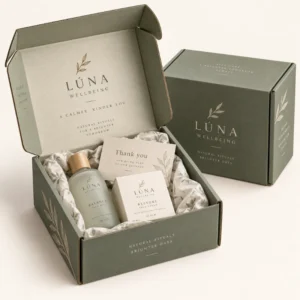
An ecommerce packaging box is a sturdy, printable carton made to carry a single online order from a packing bench to a customer doorstep in good condition. It protects the product in transit, presents the brand at the moment of opening, and should be sized so the item sits snugly without wasted space or excess void fill.
ecommerce packaging box choices for small online shops
For a small online shop, the right box starts with the product itself. Measure length, width and height, then add a small allowance for protection and for any insert or tissue wrap. A box that is only just large enough can crush a delicate edge, while a box that is far too large lets the product move, invites damage and increases postage volume. The best fit usually feels secure when the lid closes, with no bulge and no rattle when the sealed box is gently tilted.
Corrugated board is the usual choice for posting because the fluted layer absorbs knocks and stacking pressure. Single wall board suits light and robust items, while double wall board gives extra strength for heavier goods, fragile items or parcels that will travel through several sorting hubs. Paperboard mailers can suit very light, flat products, but they offer less crush resistance than corrugated board. Think about the journey as well as the product, including whether the parcel will be left outside, stacked under other parcels or handled quickly at a busy fulfilment bench.
How to size one box correctly
Start with internal dimensions, not external dimensions, because the space inside decides whether the product fits. Place the product in its usual protective wrap, then measure the wrapped item. Add room for a fitted insert if one is planned, and check that closures, flaps and any locking tabs close cleanly without forcing the board. A sample box is worth its weight here, since a drawing can hide a tight corner or a flap that fouls a label area.
Also consider the label and returns information. The outside needs a clear, flat area for the address label and any handling marks, away from folds and seams where print can distort. Inside, leave room for an invoice, a care card or a returns note if your shop includes one. Planning these details before print avoids a handsome box that is awkward to use every day.
Common sizing mistakes to avoid
The most common mistake is copying a box used for a different product and hoping it will suit a new item. Another is measuring the product alone and forgetting protective wrap, tissue or an insert. A third is choosing a depth that looks neat on screen but leaves no room for a lid to close over a soft item such as knitwear. Test with real products, real wrap and a real seal, and pack the box exactly as a member of staff would during a busy dispatch period.
Materials and print options
Kraft board gives a natural, understated look and suits brands that want a simple, recyclable feel. White board gives a cleaner canvas for bold colour, detailed illustration and photographic print. Inside print can turn the opening moment into a brand message, a pattern or a simple instruction, while outside print carries the logo and the first impression on the doorstep. Keep print legible at a glance, since a customer often sees the parcel in poor light or from a distance.
Finishes change how a box feels as well as how it looks. A matte finish reads calm and premium, while a gloss finish makes colour appear brighter. Foil and embossing can lift a logo, but they work best when used sparingly on one focal point. Whatever finish you choose, check that tape adheres well, that print does not scuff during stacking, and that any opening strip or tear feature still works after finishing is applied.
Choosing print that survives delivery
Delivery is not kind to print. Boxes rub together, tape is applied over printed areas and parcels are handled in all weather. Ask for a sample with the chosen finish, then test it by stacking, taping and opening it several times. Check edges and corners first, because those areas wear fastest. A design that still looks sharp after handling will protect your brand far better than a design that only looks good as a flat artwork file.
Packing, storage and ordering
A good ecommerce box should also work well in your workspace. Flat packed boxes save storage space and are easy to assemble, but the assembly steps must be simple enough for new staff to learn quickly. A self locking design with clear folds can speed up packing and reduce errors, while a design that needs extra tape on every seam can slow a busy day. Store boxes flat, dry and away from direct heat so board stays crisp and print stays true.
When you are ready to explore options, browse the full packaging shop range and compare structures before you commit to print. For a related range, see the ecommerce packaging boxes range for ideas on ordering more than one size. If you have artwork and dimensions ready, use the request a packaging quote page to start a conversation about specification and quantity.
Lead times and artwork approval
After final artwork approval, standard lead times are 10 to 14 working days, corrugated lead times are 12 to 15 working days, and rigid or specialist lead times are 13 to 16 working days. These are guide times for production, not a guaranteed delivery date, and they can vary with specification and quantity. Allow time for proof checking, since a careful proof stage prevents costly reprints. Check spelling, barcode placement if relevant, colour values and the exact position of folds and print areas before you approve.
For delivery detail, see the delivery information page. If you want to learn more about the business behind the boxes, visit the about Personalized Mailer Boxes page or return to the Personalized Mailer Boxes homepage.
Frequently asked questions
What size ecommerce packaging box should I choose?
Choose the smallest box that holds the wrapped product, any insert and a secure closure without forcing the board. Measure the wrapped product, test a sample with real packing materials, and check that the label area stays flat and clear.
Is corrugated board better than paperboard for posting?
Corrugated board usually gives better protection for posted orders because the fluted layer absorbs impact and stacking pressure. Paperboard can suit very light and flat items, but it offers less crush resistance on a longer postal journey.
Can I print inside and outside the box?
Yes, many brands print a bold logo outside and a message, pattern or care instruction inside. Keep the outside legible at a glance and use the inside to reward the customer at the moment of opening.
How long does production take after artwork approval?
After final artwork approval, standard production is 10 to 14 working days, corrugated production is 12 to 15 working days, and rigid or specialist production is 13 to 16 working days. These are guide times, not a guaranteed delivery date.
Do I need a sample before a full order?
A sample is strongly recommended, especially for a new size, a fitted insert or a new finish. It lets you test fit, closure, tape adhesion and print quality before committing to a full run.