
ecommerce custom packaging
Showing the single result
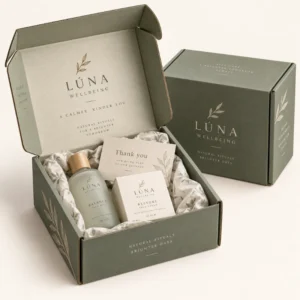
ecommerce custom packaging is packaging made to a specific online brand, with the box size, board, print and finishing chosen for that brand’s products and customers. Instead of adapting an order to a stock box, the seller adapts the box to the order, which gives a closer fit, clearer branding and a more consistent delivery experience. For a growing online shop, custom packaging turns a routine parcel into a recognisable part of the brand.
What ecommerce custom packaging can change about a delivery
A custom box changes the delivery in three practical ways. It fits the product better, so there is less movement and less filler. It carries the brand through the courier network, so the parcel is recognisable before it is opened. And it sets expectations for what is inside, because a tidy, well finished box suggests care has been taken at every stage. Those effects are cumulative: a customer who receives a good parcel is more likely to order again and to recommend the shop.
Custom does not have to mean elaborate. A single colour logo on kraft board, a clean inside message and a reliable closure can be more effective than dense artwork on every panel. The aim is a box that packs quickly, survives handling and looks intentional when it arrives. Start with the product and the journey, then add branding where it will be seen and remembered.
Starting with products, orders and handling
List your best selling products and your most common order combinations before choosing a box. Note weights, fragility, shape and whether items are sold singly, in sets or as part of a subscription. That list decides the board strength, the internal layout and the number of sizes you need. A shop that sells one main product may need a single excellent box, while a shop with a wide range may need two or three sizes that cover most orders.
Artwork, proofing and colour consistency
Good artwork preparation saves time and avoids reprints. Supply artwork at the size and resolution requested, keep essential text clear of fold lines and the label area, and check small text at printed size rather than on screen. Ask to see a proof, and check it under normal light for colour, alignment and legibility. Colours can look different on kraft board, white board and corrugated board, so a proof on the chosen material is worth more than a screen preview alone.
Print, board and finishing choices
Print can cover the outside only, the inside only, or both. Outside print carries the brand through delivery. Inside print is seen at the moment of opening, so it suits a thank you message, care guidance, a returns note or a short brand statement. Full colour print suits photography and detailed artwork, while a limited palette suits bold logos and a clean, modern look.
Board choice affects strength, print quality and feel. Corrugated board is strong and light, and it suits most online dispatch. White card gives a bright surface for detailed colour work. Kraft board gives a natural, understated look and suits brands that want a simple, recyclable feel. Rigid board gives weight and structure for premium orders, but it takes more storage space and suits a smaller, higher value range.
Finishing, closures and the opening moment
Finishing includes choices such as a matte or gloss surface, a foil detail or an embossed logo. Use finishing sparingly, on the element you want the customer to notice first. A closure also shapes the opening: a self adhesive strip speeds packing and gives a clean seal, a tuck closure suits lighter parcels, and a tear strip gives a satisfying opening without tools. Test the closure on a packed box, and check that opening does not tear printed artwork or damage the product inside.
Planning quantities, storage and reorders for ecommerce custom packaging
Quantities should reflect real order volumes, not optimism. Review recent orders, allow for seasonal peaks, and consider how many sizes you can store and manage without confusion. Ordering a single size in a larger quantity is often simpler than ordering many sizes in small quantities, but only if that size genuinely fits most orders. Keep packing guidance with each size, so new team members pack consistently.
Storage matters for custom boxes. Flat packed boxes store neatly, but they still need a dry, clean space away from direct sunlight and heavy stacking. Label stored stock by size and artwork version, and keep a sample of each current box for reference. When reordering, compare the new proof with the previous sample, so colours and dimensions stay consistent across runs.
Sustainability and producer responsibility
Custom packaging gives you control over material use. A close fit reduces filler, a single material box is easier for the customer to recycle, and avoiding unnecessary plastic layers keeps the pack simpler. Be honest in any wording printed on the box, and state the material plainly rather than making broad claims that cannot be supported.
Online sellers who place packaging on the UK market may also have duties under extended producer responsibility for packaging. The GOV.UK extended producer responsibility for packaging guidance explains who must comply, what large and small producers must do, and how packaging data is reported. Check the guidance early, because it can affect how you record the packaging you supply.
Lead times after artwork approval
For standard boxes, allow 10 to 14 working days after final artwork approval. Corrugated boxes usually take 12 to 15 working days, and rigid or specialist boxes usually take 13 to 16 working days. These are production lead times, not a guaranteed delivery date. Allow extra time for proofing, artwork revisions and peak trading periods, and keep a small buffer stock of your most used size.
Ordering ecommerce custom packaging from Personalized Mailer Boxes
Share your products, order combinations, artwork ideas and the impression you want the parcel to give, and request a quote built around that information. You can compare related options through ecommerce packaging and ecommerce mailer boxes, browse the range in the shop, and read delivery details on the delivery information page. When you are ready, send your sizes and artwork through the get a quote page.
Frequently asked questions about ecommerce custom packaging
What is ecommerce custom packaging?
It is packaging made for a specific online brand, with the size, board, print and finishing chosen for that brand’s products, orders and customers, rather than a standard stock box.
Do I need print on the inside of the box?
Inside print is optional, but it is seen at the moment of opening, so it suits a thank you message, care guidance or a returns note. Many brands print outside for recognition and inside for a short, personal message.
How do I keep colours consistent across reorders?
Specify brand colours clearly, check a proof on the chosen board under normal light, and keep a sample from the previous run to compare with the new proof before approving it.
How many custom box sizes should I order?
Most online shops do well with two or three sizes that cover single items, common bundles and larger orders. Review recent orders to find the combinations that occur most often, then design around those.
How long does ecommerce custom packaging take after artwork approval?
Standard boxes usually take 10 to 14 working days after final artwork approval, corrugated boxes 12 to 15 working days, and rigid or specialist boxes 13 to 16 working days. Allow extra time for proofing and peak periods.