
custom sizes
Showing the single result
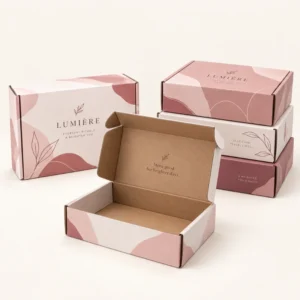
custom sizes mean that a box is made to the dimensions you specify, rather than limited to a fixed list of stock dimensions that may be close but not quite right for your product. This matters because every product has its own length, width, depth, weight and shape, and a box that follows those measurements protects better, packs faster and presents more professionally than a box with large empty spaces. Custom sizes are not a single product type; they are a way of ordering across mailers, shipping cartons, mailing boxes and rigid boxes, with the size set from the product first.
What custom sizes mean for packaging
In practice, custom sizes start with a measurement and end with a proof drawing that shows the internal size, the external size and the structure. The supplier uses that drawing to cut and score board to your dimensions, rather than pulling a pre cut size from stock. That allows for boxes that are shallow for books, deep for gift sets, narrow for bottles, wide for folded garments, or shaped around a set arrangement. It also allows for a size that fits a particular postal format, a shelf, a pallet pattern or a storage system.
Custom sizes do not mean that every dimension must be unusual. Many custom orders are only a few centimetres different from a stock size, but that small difference can decide whether a lid closes, whether a product slides, or whether a finished parcel stays within a postal format. The value is in the exact fit, not in the novelty of the size itself.
Custom sizes and stock sizes compared
Stock sizes are convenient for simple products, for short runs and for trials where the final size is not yet known. They are usually available quickly and in small quantities, and they work well when a stock box already gives a close fit with minimal filler. Custom sizes are better when a stock box leaves too much empty space, when the product has an unusual shape, when a set needs a specific arrangement, or when presentation matters enough that a loose fit would look careless.
When to stay with a stock size
Stay with a stock size if the product is robust, if the stock box already holds it snugly with a small amount of filler, and if the finished parcel sits comfortably within its postal format. Changing to a custom size in that situation adds proofing time without a clear benefit. The decision should be based on fit, protection and presentation, not on the idea that custom is always better.
How to specify custom sizes
Specify custom sizes by internal dimensions, because internal size decides fit. Give the length, width and depth of the product as packed, including any wrap, sleeve, insert or tissue. State whether the size is internal or external if you are quoting from an existing box, and ask for both figures on the proof drawing. For irregular products, give the longest, widest and tallest points. For sets, give the arrangement and the size of the whole group, including dividers.
Internal and external measurements explained
Internal size is the usable space inside the finished box. External size is the size of the closed parcel, including board thickness, tape and any outer wrap. Postal limits use external size and finished weight, so a box that fits perfectly inside may still move into a larger postal format once it is packed and sealed. Always check the finished parcel, not just the empty box, against the format you intend to use. The Royal Mail size and weight guide is a useful reference for those finished parcel limits.
Custom sizes for different products
Small products need small boxes that hold them centred, with an insert or a small amount of filler to prevent sliding. Jewellery, cosmetics samples, accessories and small electronics all benefit from a box that is only slightly larger than the product, because a large box makes a small product look lost and increases the chance of movement. A fitted insert, a foam pad or a card divider can hold a small item in place without adding much weight.
Medium products, such as candles, books, stationery sets and folded clothing, need a box that respects their proportions. A candle box must allow for the lid height. A book box must protect corners and prevent bending. A clothing box must allow a neat fold without creasing. In each case, a custom size that follows the product proportions gives a better result than a generic box that is too deep or too wide.
Larger products and sets need a box that reflects the arrangement. A gift set with several items needs dividers and a depth that allows the lid to close without pressing on the tallest item. A hamper needs a size that holds items upright and prevents them from knocking together. A bulk order needs a carton that stacks well and holds its shape under load. In all these cases, the size should be planned from the arrangement, not guessed from total volume alone.
Size ranges to think about
Think in terms of product groups rather than fixed size charts. Slim sizes suit flat items and documents. Shallow sizes suit books, calendars and folded garments. Medium depth sizes suit candles, cosmetics sets and small gift sets. Deep sizes suit shoes, ceramics with inserts, hampers and multi item orders. Within each group, the exact dimensions should still come from your product, because two products in the same group can differ enough to need different boxes.
Examples of size thinking in practice
A folded shirt needs width for the fold and depth for tissue, but not a deep box that lets the shirt unfold. A jar with a lid needs height measured with the lid on, not just the jar alone. A set of three bottles needs width for the bottles side by side, plus dividers, and depth for the tallest bottle plus a top pad. Working through those details before ordering prevents a box that is correct in one dimension and wrong in another.
Ordering boxes in custom sizes
A clear order includes the internal size, the product type and weight, the quantity, the box structure, the board preference and the print requirement. If you are unsure about board or structure, describe how the box will be used, whether it will be posted alone or inside an outer carton, and whether it will be stacked or stored flat. That context helps a supplier recommend a structure that suits the size, because a very shallow box and a very deep box place different demands on board and closure.
Standard lead times after final artwork approval are 10 to 14 working days, corrugated 12 to 15 working days, and rigid or specialist 13 to 16 working days. These are production lead times, not a guaranteed delivery date. For a first custom size, allow time for a proof drawing and a test pack with the real product, because a size error found at proof stage is easy to fix, while the same error in a full run is costly.
You can request a tailored quote with your dimensions, browse the full shop range for structure ideas, and read delivery information for planning. Related sized ranges include custom size mailer boxes, custom size shipping boxes and custom small shipping boxes, and the Personalized Mailer Boxes home page gives an overview.
Test packing a custom size
Test packing is essential for a custom size, because it confirms the fit in a way that measurements alone cannot. Pack the real product with its intended wrap and insert, close the box, check for movement, check for pressure on lids or corners, and measure and weigh the finished parcel. If the box will be stored flat before use, check that it folds and unfolds cleanly at the score lines. A test pack that passes gives confidence for the full run; a test pack that fails gives a clear fix before production.
Keeping custom sizes consistent on reorder
Keep the approved proof drawing and a sample box for every custom size you order regularly. Use those as the reference for reorders, and check new batches against the sample for internal size, board feel and print placement. Consistency matters for packing teams, who learn a size and a folding method, and for customers, who expect the same presentation on every order.
Frequently asked questions about custom sizes
What does ordering in custom sizes actually mean?
It means the box is cut to the dimensions you specify, rather than chosen from a fixed stock list. You provide the internal size you need, and the box is made to that size, with the structure, board and print you choose.
Do I need to know exact dimensions before ordering?
Yes, for the best result, measure the product as packed, including wrap and insert, and provide length, width and depth. If you are unsure, a supplier can help interpret measurements from a sample or from a clear description of the product and its packing.
Are custom sizes only for unusual products?
No, many custom sizes are only slightly different from stock sizes, but that small difference can improve fit, protection and postal format. Custom sizes are useful whenever a stock box leaves too much empty space or compromises presentation.
How long does production take after artwork approval?
Standard production is 10 to 14 working days after final artwork approval, corrugated is 12 to 15 working days, and rigid or specialist is 13 to 16 working days. These are production lead times, not a guaranteed delivery date.
Can I order several custom sizes in one run?
Yes, different sizes can be ordered for different products or sets, although each size needs its own proof and specification. Keeping a clear list of sizes, products and quantities helps avoid confusion during production and packing.