
custom shipping boxes
Showing all 2 results

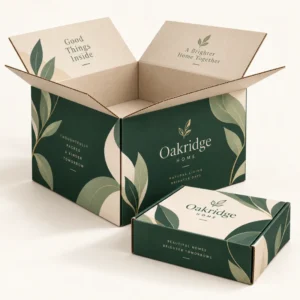
For a business that posts products every day, custom shipping boxes provide a practical way to protect goods, present a brand clearly and reduce wasted space inside a parcel. A box made to the right size holds the product firmly, needs less filler and is easier to pack, stack and label. When the board, print and closure suit the journey, the parcel is more likely to arrive in good condition and to look professional when it is opened.
How custom shipping boxes protect goods in transit
A shipping box has to do more than hold a product. It must absorb knocks, resist crushing when parcels are stacked and keep its shape through sorting, loading and delivery. Corrugated board is widely used for this work because the fluted layer between two flat sheets creates strength without adding a great deal of weight. The right board grade depends on the weight of the contents, the fragility of the product and the distance it will travel. A light item in a strong box may be over specified, while a heavy item in a thin box risks damage that could have been avoided at the design stage.
Fit matters as much as board strength. A box that is much larger than the product allows movement inside the parcel, and that movement is a common cause of scuffs, dents and breakage. A box that is too tight can press on corners, damage packaging inside or make the parcel hard to seal. Measuring the product with any inner packaging in place gives a more reliable starting point than measuring the product alone. It is also worth checking how the packed parcel will be handled, whether it will be stacked, whether it will travel flat or on its side and whether a label and any handling marks will remain clearly visible.
Choosing a box style for the product
Regular slotted cartons are a familiar choice for general shipping. They fold from a flat sheet, close with tape and suit a wide range of products, from single items to multi item orders. Mailer style boxes with a tuck in lid or a self sealing flap can give a neater opening experience and may need less tape. For heavier or fragile goods, a stronger board or a double wall construction can add protection, especially where parcels are stacked in a warehouse or a vehicle. The choice should follow the product, not the other way round, and a short test pack is often the fastest way to spot a problem before a full order is placed.
What to check during a test pack
Pack the product exactly as it will be posted, seal the box in the usual way and check the corners, the closure and the label area. Shake the parcel gently and listen for movement, then check whether the product has shifted or whether inner packaging has compressed. Try stacking another packed parcel on top if that reflects real handling. If the box bulges, if the tape lifts or if the product touches the outer wall, change the size, the board or the inner protection before ordering in quantity. A small change at this stage can prevent a larger problem later.
Materials, sizes and print for custom shipping boxes
Most custom shipping boxes are made from corrugated board, with kraft board giving a natural brown finish and white board giving a brighter surface for print. Kraft suits a plain, practical look and a simple logo, while white board can make full colour artwork stand out. Recycled content and recyclability are worth discussing at the quote stage, because the board, the print and any coating or tape all affect how easily a customer can recycle the box after delivery. A clear note on the box about recycling can help the customer, but it should describe the finished box honestly rather than making a broad claim.
Sizes should be based on internal measurements, because the space inside the box is what the product must fit. Length, width and depth should be measured in that order and checked against the packed product, including any sleeve, tray or cushioning. It helps to keep a small range of sizes for repeat orders rather than creating a new size for every product. A small range is easier to store, easier for a packing team to learn and easier to reorder accurately. For products that vary a little in size, a well chosen insert or divider can be more useful than a completely new box.
Print options that suit shipping
Print on a shipping box can be as simple as a logo on one panel or as complete as artwork across the outside and inside. Single colour print is often clear and practical for handling marks, a web address and a logo. Full colour print suits a brand that wants the parcel to carry its identity from the moment it is seen. Inside print is useful for a welcome message, care instructions or a repeat order prompt, because it is revealed at opening rather than during transit. Whatever the coverage, artwork needs to stay legible after handling, so small text and fine detail should be tested at real size.
Artwork points to confirm before approval
Confirm the logo file, the colours and the exact placement on each panel before final artwork approval. Check that text does not sit too close to a fold or a closure, where it could crease or be hidden by tape. Check that a barcode area, if one is needed, is left clear and that handling marks are not printed over a seam. A proof viewed at actual size is more useful than a small screen preview, because it shows how the design will look on the finished box. Once artwork is approved, standard lead time after final artwork approval is 10 to 14 working days, while corrugated boxes are 12 to 15 working days. These times are planning guides, not a guaranteed delivery date.
Packing, labelling and storage for custom shipping boxes
Good packing starts with a consistent routine. Place the product centrally where possible, add cushioning only where it is needed and seal the box firmly so the closure does not lift in transit. Too much filler can make a parcel larger and heavier than it needs to be, while too little filler can leave the product free to move. Paper void fill, corrugated dividers and fitted inserts each have a place, and the best choice depends on whether the product is fragile, heavy, oddly shaped or made up of several parts. A packing guide with photographs can help a growing team keep standards steady.
Labelling also deserves attention. The delivery label should sit flat on a single panel, away from a seam or an edge where it could peel or crease. If a box carries printed branding, keep the label area in mind during design so the label does not cover the logo or an important message. For parcels that may be returned, a clear return instruction inside the box can save time and reduce confusion. Storage matters too. Boxes are usually supplied flat, which saves space, but they should be kept dry, flat and away from damp floors so the board stays strong until it is needed.
Planning quantities and repeat orders
Ordering for custom shipping boxes should balance storage space, cash flow and the risk of running out during a busy period. A larger order can simplify repeat packing, but it needs dry storage and a clear record of the size, board and artwork used. Keep a sample of the approved box and a note of its internal measurements, so a repeat order can be checked against the original rather than from memory. If a product changes, even slightly, check the fit again before reordering the same box, because a small change in a product can affect the whole pack.
Keeping quality steady across orders
Agree what a good box looks like before a large order is placed. Note the board colour, the print quality, the fold strength and the closure, and check a sample from each delivery against those points. If a problem appears, record which batch it came from and describe the fault clearly, with photographs where helpful. That record makes it easier to resolve the issue and to prevent the same fault in the next order. A steady specification also helps a packing team, because they can rely on the box behaving the same way every time.
Ordering custom shipping boxes on a quote basis
Because size, board, print and quantity all affect the work involved, custom shipping boxes are supplied on a quote basis rather than from a standard catalogue listing. A quote request should include the product size, the packed size if it differs, the board or finish preferred, the print coverage, the quantity and the delivery location. Sharing a photograph of the product and its current packaging can also help, because it shows the shape, the fragility and any feature that needs protection. The more complete the brief, the more accurate the quote and the fewer revisions are needed.
It is worth using the quote stage to ask about lead time, artwork format and any practical limits, such as a size that would be awkward to stack or a finish that would not suit a damp journey. For a first order, ordering a proof or a small trial quantity, where available, can reduce risk. Once the box is approved, keep the specification on file for future orders. For size planning, see the Royal Mail size and weight guide and for packaging responsibilities, see the GOV.UK packaging producer responsibilities page. For related ideas, see custom shipping boxes uk and custom shipping boxes wholesale. To start a request, use the request a quote page and check delivery information for planning.
What to include in a quote request
List the product, its weight, its packed dimensions and the number of boxes needed. State whether print is required on the outside only or on the inside as well, and whether a logo, full artwork or simple handling text is planned. Note any insert, divider or special closure, and note the date by which the boxes are needed for planning, without treating that date as a promise until it is confirmed. A clear brief helps the supplier check feasibility and suggest a practical alternative if the first idea would not work well in transit.
Checking the quote before approval
Read the quote against the brief, panel by panel. Confirm the internal size, the board, the print coverage, the quantity and the artwork approval step. Confirm the lead time after final artwork approval and allow time for packing and posting after the boxes arrive. If anything is unclear, ask before approving artwork, because changes after approval can add time. Keeping the approved proof and the quote together makes future reorders simpler and reduces the chance of a specification drifting over time.
Frequently asked questions
What are custom shipping boxes?
Custom shipping boxes are boxes made to a chosen size, board and print specification for posting products. They differ from a standard stock box because the fit, the strength and the branding are selected for a particular product and journey.
How do I choose the right size?
Measure the product with its inner packaging in place, then add only enough room for cushioning and a secure closure. Test pack the product and check for movement, bulging and label placement before ordering in quantity.
Are corrugated boxes suitable for fragile items?
Corrugated board can protect fragile items well when the board grade, the box size and the inner cushioning suit the product. A test pack is the best check, especially for glass, ceramics or items with delicate corners.
Can I print a logo on a shipping box?
Yes, a logo can be printed on one panel or as part of fuller artwork across the box. Check legibility at real size and keep text away from folds, seams and the delivery label area.
How long do custom shipping boxes take after artwork approval?
Standard lead time after final artwork approval is 10 to 14 working days, while corrugated boxes are 12 to 15 working days. Rigid or specialist boxes are 13 to 16 working days. These are planning guides, not a guaranteed delivery date.