
custom mailer box packaging
Showing all 2 results
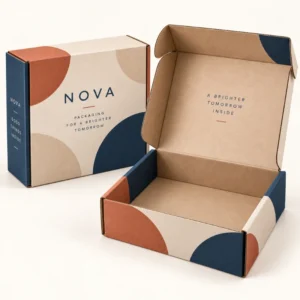
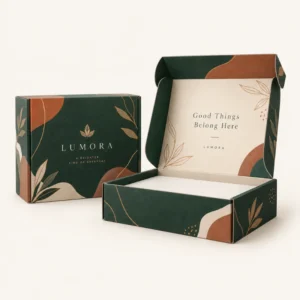
Custom mailer box packaging is the complete system around a mailer box, including the box itself, any insert, tissue or sleeve, print inside and out and the way the finished parcel is sealed and labelled. It treats packaging as one experience, not as separate items bought in isolation. When the parts are planned together, custom mailer box packaging opens smoothly, the product is protected and the brand feels consistent from the first glance to the last item lifted out.
What custom mailer box packaging includes
A complete mailer packaging system usually starts with the outer box, which provides structure and branding. Inside, an insert or divider holds products in place. Tissue paper softens the opening and protects surfaces. A card, sleeve or belly band can carry a message, instructions or a promotional note without cluttering the box itself. Tape, labels and any outer protection complete the system. Each element has a job, and each should be chosen for how it works with the others, not only for how it looks on its own.
Planning the system together avoids common mismatches. An insert designed without the tissue thickness in mind can make the lid hard to close. A card placed under the product can be missed entirely. A sleeve designed for one box size can look loose on another. By specifying box, insert and extras together, you get a pack that assembles quickly, travels well and opens in the order you intended.
The outer box as the foundation
The outer mailer box sets the tone. Its size determines how much can fit, its board determines protection and its print determines first impressions. A fine flute corrugated board gives a smooth print surface and a neat retail feel, while a stronger grade may be needed for heavier sets. Colour choice matters too. Kraft gives a natural, craft led feel. White gives a clean base for bright artwork. A printed pattern on the outside can make the parcel recognisable in a delivery pile, while a restrained logo can feel more premium.
Choosing a box that suits the whole system
Choose the box after deciding what will go inside it, not before. List every item, insert, card and tissue layer, then size the box to that total. Check lid closure with everything in place, because a system that works without tissue may fail once tissue and a card are added. A box that is slightly deeper than the minimum can be better than a box that is exactly the product height, because it leaves room for a neat tissue fold on top.
Inside the pack: inserts, tissue, cards and sleeves
Inserts organise products, tissue protects and softens, cards communicate and sleeves add a finishing layer. Tissue can be plain, printed with a pattern or printed with a logo, and it can be folded in a consistent way so every opening looks the same. A card on top of the tissue is ideal for a thank you note, care instructions or a discount code for a next order. A sleeve around the closed box can turn a standard mailer into a seasonal or limited edition pack without changing the box itself.
Keep extras purposeful. Every extra layer should earn its place by protecting, informing or delighting. Unnecessary layers slow packing, increase waste and can confuse the customer about what to keep. If an extra does not improve protection or the opening experience, leave it out. Simplicity often looks more premium than a pack crowded with inserts, cards and fillers that compete for attention.
Branding the system, not just the box
Branding should run through the system in a restrained way. Use the same colours, type style and tone on the box, insert and card, but vary the emphasis. The box can carry the main logo. The insert can carry a subtle pattern or a small logo. The card can carry the message in full. That hierarchy guides the eye and prevents the pack from feeling like a collection of unrelated printed items that happen to share a box.
Messages that help the customer after opening
Useful messages include care instructions, assembly guidance, recycling information and a clear next step, such as how to reorder or how to contact support. Place practical information where it will be found, usually on a card on top of the tissue or printed inside the lid. Avoid placing essential instructions only on the outside of the box, where they may be covered by a label or removed with outer packaging.
Planning, sustainability and ordering custom mailer box packaging
Sustainability should be planned at system level. A recyclable box loses some of its benefit if it is paired with non recyclable foam, mixed material tape and a plastic sleeve that cannot be separated. Where possible, choose paper based inserts, tissue and cards that can be recycled with the box, and keep finishes simple so the finished pack remains easy to recycle. Tell customers clearly what can be recycled and what should be separated, because clear guidance increases the chance that packaging is actually recycled.
Packing efficiency is part of sustainability too. A system that packs quickly uses less labour and less material, because staff are not improvising with extra fill. Standardise the packing order, store components together and test the full system with new staff. If a step is confusing, simplify the design rather than adding instructions. A good system should be obvious after one demonstration.
To order a complete system, share product dimensions and quantities, the items per parcel, any insert needs and artwork for box, insert and cards. Related pages include custom mailer box for presentation led orders, custom mailer box inserts that hold products secure and the full shop range. After final artwork approval, standard lead times are 10 to 14 working days, corrugated boxes are 12 to 15 working days and rigid or specialist boxes are 13 to 16 working days. These are production lead times, not a guaranteed delivery date. For delivery details, see the delivery information page and request a tailored quote through the get a quote form.
Testing the complete pack before launch
Test the complete pack as a customer would receive it. Pack it, seal it, post a test parcel and open it without prior knowledge of the intended order. Note what is seen first, what is easy to lift out, what is confusing and what feels wasteful. Ask a colleague who was not involved in the design to do the same test. Fresh eyes often spot a card that is hidden, tissue that tears or an insert that is hard to remove.
Reviewing the system after real orders
After launch, review damage reports, packing times, component waste and customer comments together. A system that protects well but packs slowly may need a simpler insert. A system that looks beautiful but generates damage reports may need stronger board or a better fit. Small, evidence led changes keep the system improving without a complete redesign every season.
Frequently asked questions
What is the difference between a mailer box and mailer box packaging?
A mailer box is the box itself. Mailer box packaging is the complete system, including insert, tissue, cards, print and sealing, planned together so the whole parcel works as one experience.
Do I need tissue and a card as well as an insert?
Not always. Tissue suits products that need surface protection or a softer opening. A card suits messages, instructions or offers. Use each element only where it adds protection, information or delight.
Can packaging be sustainable and premium at the same time?
Yes, when materials are chosen as a system. Paper based inserts, tissue and cards, simple finishes and clear recycling guidance can look premium while keeping the pack easy to recycle.
How long does production take?
After final artwork approval, standard lead times are 10 to 14 working days, corrugated boxes are 12 to 15 working days and rigid or specialist boxes are 13 to 16 working days. These are production lead times, not a guaranteed delivery date.
Should I order all components together?
Ordering together is usually better, because box, insert and extras can be sized and proofed as one system. That reduces mismatches, such as an insert that does not fit once tissue is added.