
cardboard book wraps
Showing the single result
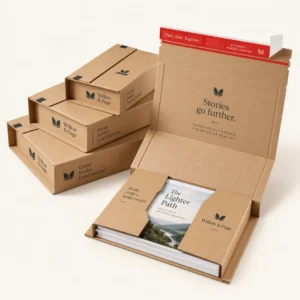
cardboard book wraps are wraparound cardboard mailers that fold around a book or another flat item and adjust to its thickness. They grip the contents closely, protect corners and edges, and seal with a simple strip, so the finished parcel stays slim and secure. Booksellers, publishers, print shops and online sellers use them for single books, catalogues, calendars, framed prints and vinyl records.
The wraparound design is the key difference from a fixed depth box. Instead of filling empty space with void fill, the wrap folds to meet the item, which keeps the parcel tidy and reduces movement in transit. That close fit also helps the parcel look professional when the customer opens it.
How cardboard book wraps work
A book wrap starts flat, with scored folds that let it bend around the item in stages. You place the book on the wrap, fold the sides in, then fold the outer flap over and seal it. Multi scored panels give a range of depths, so one wrap size can suit a thin paperback one day and a thicker catalogue the next.
Variable depth and why it matters
Variable depth means the wrap does not force every order into the same parcel thickness. A thinner item gives a slimmer parcel, which can help with postal size bands and with storage in a delivery cage or a post room. A thicker item still gets a firm fit, because the folds take up the extra depth rather than leaving the book loose inside a deep box.
Scored folds in plain language
Scores are shallow creases pressed into the board at set intervals. They guide the fold, keep the edge neat, and stop the board cracking when it bends. When you pack, fold along the score nearest the thickness of your item and press the seal flat for a clean finish.
Sealing, opening and reuse
Most cardboard book wraps seal with a peel and seal strip and open with a tear strip, so packing is fast and opening does not need a blade near the book cover. Some recipients can reuse a wrap for a return, provided the board is still clean and the seal area is intact. If you expect returns, mention that option on your packing note so customers know the wrap can go back in the post.
What cardboard book wraps are best for
Book wraps suit any flat or fairly flat product that needs rigid protection without a bulky box. They are a strong choice for paperbacks, hardbacks, brochures, magazines, art prints in a protective sleeve, board games in a slim case and records in a sleeve. For very heavy or irregular items, a deeper postal box may be safer, because a wrap is designed to hug a flat shape rather than to hold a loose collection of parts.
Books and printed media
Publishers and second hand booksellers use wraps daily because they cope with mixed stock. One size can cover several formats, which cuts the number of packaging lines on the shelf. For signed or limited editions, add a protective sleeve around the book first, then wrap it, so the cover never touches the board directly.
Prints, calendars and flat art
Flat art needs the same rigid protection as a book, with extra care for surface marks. Place the print in a sleeve, lay it flat on the wrap, and check that no fold presses across the image area. A wrap that is slightly larger than the print gives a margin of board around the edge, which takes knocks before they reach the artwork.
Choosing the right size of wrap
Measure the item closed, then choose a wrap whose length and width give a small margin around it. Depth matters just as much, so check the maximum depth of the wrap against your thickest item. A wrap that is too short will leave a corner exposed, while a wrap that is far too wide will fold awkwardly and may leave a loose flap.
A practical sizing routine
Keep your three best selling formats on the bench and test each wrap size against them. Fold, seal and label a sample parcel, then check the seal, the corners and the overall thickness. That trial takes a few minutes and prevents a costly mismatch when a full order arrives. For a rigid envelope style alternative, see cardboard book mailers on this site.
Postal size bands to keep in mind
Postal services set limits on length, width, thickness and weight, and a slimmer parcel can sit in a lower band. Always measure the finished, sealed parcel rather than the flat wrap, because the fold and the seal add a little thickness. The Royal Mail guidance on sending small parcels explains maximum sizes for small parcels and gives practical packing advice.
Materials and sustainability
Most cardboard book wraps use corrugated board with a kraft outer face, which gives strength, a clean look and a surface that takes labels well. Corrugated board combines a fluted inner layer with flat outer layers, so it resists bending while staying light. Many wraps use recycled content and are recyclable with paper and card when clean and dry.
Recycling after delivery
Ask customers to remove tape and labels where practical and to place the wrap in paper recycling. A short note on the parcel or on an order insert can prompt that step without adding clutter. If you print wraps, keep print away from the seal and the label area, and choose inks and finishes that still allow recycling where possible.
Storage in a busy packing area
Wraps arrive flat, so they store neatly on a shelf or in a rack and take far less space than made up boxes. Keep them dry, flat and away from direct heat, and store the most used sizes at bench height so packers do not need to reach or bend for every order.
Printed cardboard book wraps
A printed wrap turns an ordinary delivery into a branded moment, with a logo, a colour block or a short welcome message on the outer face. Keep the design simple and leave a clear space for the label, because a label placed over print can be hard to scan. Agree the wrap size before final artwork, so text and logos sit correctly on every size in the range.
For printed corrugated packaging, the site gives lead times after final artwork approval at 12 to 15 working days. Use that as a planning guide rather than a guaranteed date, and allow time for proofing. To start a printed wrap project, use the request a quote page and include your item sizes and expected quantities.
Frequently asked questions
What is the difference between a book wrap and a book mailer?
A book wrap folds around the item and adjusts to its thickness, while a rigid book mailer is closer to a strong envelope with a capacity fold. Both protect flat items, but a wrap usually gives a closer fit across a wider range of thicknesses.
Do cardboard book wraps need extra padding?
Often they do not, because the corrugated board and the close fit provide the main protection. Add a sleeve or a thin cushioning layer for signed editions, glossy covers or framed prints that could mark easily.
Can I post vinyl records in a book wrap?
Yes, provided the wrap size fits the record sleeve with a margin around the edge and the seal closes flat. Place the record in its sleeve first and check the finished parcel thickness against your postal service limits.
Are cardboard book wraps recyclable?
Most are recyclable with paper and card recycling when clean and dry. Remove tape and labels where practical, and check local guidance if the wrap has a plastic coating.
How fast can I pack with a book wrap?
Once the size is chosen, packing takes only a few folds and a press on the seal strip. A consistent routine, with wraps stored at bench height, keeps packing speed high during busy periods.