
book wrap mailers
Showing the single result
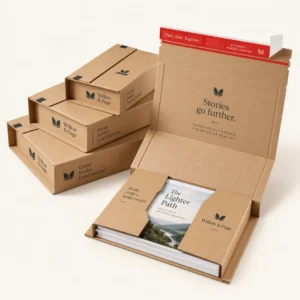
For posting a single book or a slim set, book wrap mailers are a smart choice because a flat sheet of corrugated cardboard folds around the book, creases to its thickness and seals neatly, giving a snug parcel with little wasted space. They suit booksellers, publishers, authors and online sellers who post paperbacks, catalogues, magazines and similar flat items every day. The wrap protects corners and covers, keeps the parcel light for posting, and opens cleanly for the recipient.
Choosing book wrap mailers for your books
Start with the largest book you will post in that wrap, then check that the wrap can also fold down neatly for thinner titles. A wrap with scored fold lines adjusts to different thicknesses, so one size can cover a range of paperbacks. If you post a wide range of formats, keep two or three wrap sizes in stock rather than trying to make one wrap fit everything.
Common sizes and formats
Wraps are commonly sized around A5, A4 and C4 formats, with adjustable depth that can range from a slim single volume to a stack of two or three thin books. A5 wraps suit small paperbacks and pocket guides, A4 wraps suit standard paperbacks and catalogues, and larger wraps suit illustrated books, portfolios and board games with a flat profile. Always compare internal measurements with the book, not just the format name.
How adjustable depth works in practice
Scored lines across the wrap let the packer fold the board at the point that matches the thickness of the book. This creates a firm side wall, stops the book sliding, and keeps the finished parcel flat and tidy. Practice on a sample first, because a clean fold at the right score line is what gives the parcel its professional look.
Materials, protection and board strength
Book wrap mailers are usually made from corrugated cardboard, which gives rigidity without much weight. Reinforced edges and double thickness corners add protection where damage is most likely. For valuable or signed books, add a protective sleeve before wrapping, so the cover is not scuffed when the book is placed in the wrap or taken out again.
Sealing and opening
Many wraps use a peel and seal strip, which speeds up packing and gives a tamper evident seal. A tear strip lets the recipient open the parcel without a knife near the book, which is a thoughtful detail for a reader. Test the seal on a packed sample and check that it holds when the parcel is turned over, because a seal that lifts in transit can expose the book to dust and damage.
Printing wraps with your brand
Printed wraps can carry a logo, a short thank you message, a returns note or a simple instruction for opening. Keep the print away from fold lines where possible, and leave a clear area for the address label. A branded wrap makes a small parcel feel like part of a considered service, even when the order itself is modest.
Packing books in wrap mailers step by step
Place the book centrally on the open wrap, with the spine supported and the cover facing up. Fold the side panels in first, then fold the wrap around the book at the correct score line, pressing the edges firmly so the parcel holds its shape. Seal the strip, check that no corner is exposed, and place the address label on a flat surface where it will not peel at an edge.
Books and other flat items that suit wraps
Wraps suit paperbacks, hardbacks of modest thickness, magazines, catalogues, calendars, prints, vinyl records in a protective sleeve, board games with a flat profile and similar items. They are less suited to very thick, heavy or irregularly shaped items, which need a deeper box with more internal support. If a book is unusually thick, move up to a shipping box rather than forcing a wrap closed.
Reducing waste and storing wraps flat
Wraps are supplied flat, so they take up little shelf space and are easy to store in a dry room. Because the wrap folds to the thickness of the book, it uses less void fill than a large box, and the cardboard can usually be recycled after use if it is clean and dry. Keep a small stock of each size near the packing bench so packers are not tempted to use an oversized box for a slim book.
Ordering and production timing for printed wraps
Custom printed wraps are produced after final artwork approval. Standard lead times after final artwork approval are 10 to 14 working days, and corrugated formats are 12 to 15 working days. These figures are production times only and are not a guaranteed delivery date. If you are planning a book launch or a busy sales period, request a quote early and agree the sizes you will need for the main titles.
For related packaging, see book postal boxes for books sent by post, book wrap mailers uk for UK posting and request a quote for custom printed book wraps. Size guidance is also available on the Royal Mail UK parcel and letter services page.
Frequently asked questions
What are book wrap mailers?
They are flat corrugated cardboard wraps that fold around a book, adjust to its thickness and seal neatly for posting.
What sizes do book wrap mailers come in?
Common sizes relate to A5, A4 and C4 formats, with adjustable depth for different book thicknesses. Measure your largest book and compare internal measurements before ordering.
Are book wrap mailers suitable for hardbacks?
Yes, for hardbacks of modest thickness, provided the wrap fits closely and the corners are protected. Very thick or heavy hardbacks may need a deeper shipping box.
Can book wrap mailers be printed with my logo?
Yes, printed wraps can carry a logo and a short message. Keep print clear of fold lines and leave space for the address label.
How do I open a book wrap mailer without damaging the book?
Use the tear strip where one is provided, and open the wrap away from the cover. Avoid using a knife close to the book inside.