
bespoke packaging boxes
Showing the single result
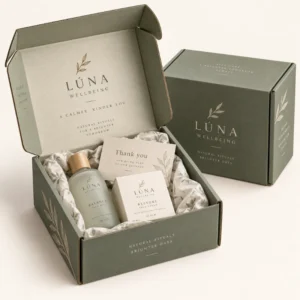
bespoke packaging boxes are boxes designed from your product and brand, rather than chosen from a fixed stock range. Size, board, structure, print and finish are all specified to suit what goes inside and how the box will be used. That tailored approach gives better protection, a cleaner presentation and a box that feels like a deliberate part of the product.
What bespoke packaging boxes can cover
The term covers a wide range of formats, from a simple folding carton for a retail product to a strong corrugated mailer for postal delivery and a rigid presentation box for a gift. What they share is a starting point in the product itself: its dimensions, weight, fragility and selling route. A box that begins with those facts is far more likely to perform well than a box chosen mainly for its appearance.
Bespoke boxes also help brands stay consistent. When size, colour and finish are recorded for each product, reorders match earlier runs and the whole range looks coherent on a shelf or in a delivery photograph. That consistency is especially valuable for brands with several products, seasonal editions or a growing retail presence.
Main box structures to know
Folding cartons are light, printable and ideal for retail items that need clear branding and a tidy shelf presence. Mailer boxes are stronger, with a self locking style closure, and suit postal and ecommerce orders. Corrugated shipping boxes give the highest protection for heavier or fragile goods in transit. Rigid boxes, with a separate lid or a magnetic style closure, suit premium and gift products where the opening itself is part of the experience.
Choosing between carton, mailer and rigid formats
Choose a folding carton when print quality and shelf appeal matter most and the product is light and not fragile. Choose a mailer when the box must survive delivery and open well without extra outer packaging. Choose a rigid box when the product is premium, the box may be kept after purchase, or the presentation needs to feel substantial from the first touch.
Materials, board and print
Kraft board offers a natural, uncoated look and a warm brown tone that suits artisan, food and botanical brands. White card offers a bright, smooth surface for vivid colour and fine detail. Corrugated board, with its fluted inner layer, adds cushioning and stacking strength. Rigid board, wrapped in printed paper or a textured finish, gives a firm shell that holds its shape.
Print options include full colour artwork for photography and complex designs, plus simpler one or two colour print for a clean, understated look. Finishes such as matte or gloss lamination protect the surface and change the feel, while foil, embossing and spot UV highlight selected details. Choose finishes that support the design, rather than adding every option at once.
Getting colour and detail right
Specify brand colours clearly and check a proof at real size. Colours can shift between screen and print, and small text can become hard to read if it is reduced too far. Check folds, corners and closures on the proof, and confirm that important information is not placed where a fold or a seal will obscure it. A careful proof stage saves time and avoids a full run with a small but visible error.
How to specify bespoke packaging boxes
Begin with accurate measurements of the finished product, including any lid, cap, handle or protruding part. Note the weight and fragility, and describe how the box will be packed, stored and delivered. If items are packed in sets, note how they should be arranged and whether dividers or inserts are needed to keep them apart.
Next, decide on the customer experience. Should the box open like a book, lift off cleanly, or tear open quickly? Should the inside carry a message, instructions or a simple pattern? These decisions shape the structure more than decoration does, and they are easier to set at the start than to change after tooling and artwork are complete.
Quantities, storage and reorders
Think about storage as well as unit cost. Flat packed cartons and mailers store efficiently, while assembled rigid boxes need more space. If storage is tight, a flat format or a collapsible rigid design may be more practical. Keep a specification sheet for each box, covering size, board, print, finish and insert, so a reorder can be placed without remeasuring the product.
Seasonal products need extra planning. A design that works for a core range may need a variant for a gift edition, with a different print or finish but the same structure and size. Keeping the structure constant makes packing and storage simpler, while the print change gives the seasonal edition its own identity.
Lead times after artwork approval
For standard boxes, allow 10 to 14 working days after final artwork approval. Corrugated boxes usually take 12 to 15 working days, and rigid or specialist boxes usually take 13 to 16 working days. These are production lead times, not a guaranteed delivery date. Allow time for proofing and for any artwork revisions, especially when several products are being specified together.
Ordering bespoke packaging boxes from Personalized Mailer Boxes
Share your product dimensions, quantity, selling route and the look you want, and request a quote for boxes built around that brief. You can explore related formats through bespoke ecommerce packaging and bespoke shipping boxes, browse the range in the shop, and check delivery details on the delivery information page. When you are ready, use the get a quote page to send your brief.
Frequently asked questions about bespoke packaging boxes
What makes a box bespoke?
A bespoke box is specified for a particular product and brand, including its size, board, structure, print and finish, rather than selected from a standard stock range.
Which is stronger, a carton or a corrugated box?
Corrugated board is generally stronger for transit because its fluted layer adds cushioning and stacking strength. A folding carton is lighter and better suited to retail presentation of light, non fragile products.
Can bespoke packaging boxes be printed inside?
Yes, interior print is a popular option. It can carry a message, instructions, a pattern or a brand mark that appears when the customer opens the box.
Do I need inserts for bespoke packaging boxes?
Inserts help when products are fragile, move easily, or are sold as sets. They hold items in place, protect vulnerable parts and present the contents in a planned arrangement.
How long do bespoke packaging boxes take after artwork approval?
Standard boxes usually take 10 to 14 working days after final artwork approval, corrugated boxes 12 to 15 working days, and rigid or specialist boxes 13 to 16 working days.