
the mailer box
Showing the single result
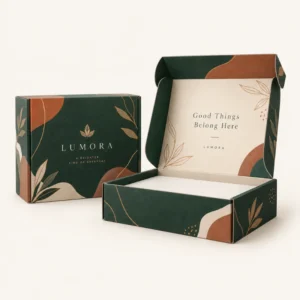
The mailer box is a corrugated box designed to post a product safely and present it well when it is opened. It folds from a single sheet of board, locks shut without a separate lid, and can be printed inside and out so the delivery itself carries the brand. For online sellers, the mailer box replaces the combination of a plain shipping carton plus a separate retail pack, because one box does both jobs.
What the mailer box is
A mailer box is often called a postal box, a shipping mailer or an ecommerce box, but the structure is the same idea. It arrives flat, folds up quickly, and uses tuck flaps, locking ears or a self seal strip to close. That flat arrival saves storage space and delivery volume before packing, which matters for small businesses with limited room. Once assembled, the double thickness front and side walls in many styles give the box a firm feel that a single wall carton lacks.
The mailer box differs from a standard shipping carton in presentation as well as structure. A shipping carton is built mainly for protection and stacking, and its print is usually limited to a label or a simple mark. A mailer box is built for protection and for the opening moment, so print, colour and inside lid design are part of the specification from the start. That difference is why mailers suit direct to customer brands, subscription services and gift sellers, while plain cartons suit bulk freight and warehouse moves.
Common mailer box styles
Roll end tuck front mailers are the most widely used style. The ends roll in to form double walls, and the front tucks into the base for a firm close without tape on the main closure. Tuck top mailers are lighter and suit flat, light goods, with a lid flap that tucks into the front wall. Self seal mailers add a peel and seal strip for fast packing, and tear strip versions add an easy opening perforation. Side loading mailers suit long or flat items that slide in from one end.
Choosing a closure for your packing line
Choose a tuck closure when staff pack at a bench and want a neat, tapeless close that still looks smart. Choose a self seal closure when speed matters most and orders are packed in high volume, because peeling a strip is faster than taping a seam. Choose a tear strip closure when the customer experience matters most, because the opening becomes part of the brand moment. Test each closure with the real product, because a closure that works for a light garment may not suit a heavy book set.
Materials, sizes and print for the mailer box
Corrugated board is the usual material, with E flute for slim, print friendly boxes and B flute for stronger, more protective boxes. Kraft board gives a natural look and suits brands that want a recyclable, understated parcel. White board gives brighter, more accurate colour for detailed artwork and photography led designs. Rigid board is a different category, used for premium presentation boxes that are not folded flat in the same way, and it suits high value gift sets rather than everyday posting.
Sizes should follow the product, not a catalogue list alone. Measure the product with its insert, tissue or protective wrapping, then allow a small margin for easy packing and for the lid to close without strain. Too much empty space lets the product shift and looks careless on opening. Too little space strains seams and can damage the product. A sample made to the exact internal size is the best proof, and it also shows how the product sits on first sight. You can tear strip packaging guidance if an easy opening strip is part of your plan.
Print inside and outside the box
Outside print carries the brand before the box is opened, so keep it bold, legible and consistent with the website and product packaging. Inside lid print carries the message at the moment of opening, so keep it short and warm, with a thank you, a care note or a simple pattern that photographs well. Full colour print suits photography and illustration, while one or two colour print can look sharp and modern on kraft board. Check colour on the chosen board, because kraft mutes colour compared with white board.
Inserts that keep products in place
An insert stops movement, separates multiple items and presents the product at the right height on opening. Die cut board inserts suit most mailers and keep recycling simple. Foam inserts suit delicate or heavy items that need cushioning on all sides. Tissue and a card can add a gift feel without a full insert, provided the product itself is held firmly. Whatever insert is used, test it by turning the packed box gently and checking that nothing shifts or rattles.
Ordering the mailer box on a quote basis
Custom mailers are made to size and artwork, so the site works on a quote basis. After final artwork approval, corrugated boxes are usually made in 12 to 15 working days as a guide, not as a guaranteed date, and rigid or specialist constructions follow a longer guide on the delivery page. Planning a launch should allow time for a sample and for any artwork revision, because a sample that is tested properly saves far more time than it takes. You can request a custom quote with product dimensions, quantity, board preference and print ideas.
For a first order, start with one size that covers the most common order, rather than a full range of sizes at once. That approach keeps stock simple, lets you test the design with real customers and gives a clear base for adding sizes later. If orders vary widely, a second size for large or multi item orders can be added once the first size has proved itself in transit.
What to include in a brief
Include product dimensions and weight, items per box, board and colour preferences, print areas, insert needs and quantity. Mention the delivery route, whether the parcel goes by post or courier, and whether the customer or a gift recipient will open it. Mention any seasonal peak, because a launch date affects how early the sample stage should start. A complete brief usually means fewer questions and a faster quote.
Sustainability and recycling
Corrugated mailers made from paper board are widely recyclable, and choosing paper based inserts and tape keeps the whole parcel easier to recycle. Avoid mixed materials where a paper alternative works, and keep plastic windows and foam only where protection genuinely requires them. Clear recycling guidance on the inside lid or on a card can help customers dispose of the box correctly, without turning the parcel into a lecture.
Frequently asked questions
What is the difference between a mailer box and a shipping carton?
A mailer box is a self locking, print ready box for direct to customer orders, while a shipping carton is usually a plain protective carton for bulk transport. A mailer combines protection and presentation in one box.
Do mailer boxes need tape?
Many mailer styles close without tape on the main closure, using tuck flaps or locking ears. Tape may still be used on the base or for extra security on heavy parcels, depending on the style and the journey.
Can a mailer box be printed inside as well as outside?
Yes. Outside print carries the brand on arrival, and inside lid print creates the reveal when the box is opened. Both areas can be designed together for a coherent unboxing moment.
How do I choose a mailer box size?
Measure the packed product with its insert and wrapping, allow a small margin for easy packing, and test a sample. The box should hold the product snugly without strain or excess movement.