
personalized candle boxes
Showing the single result
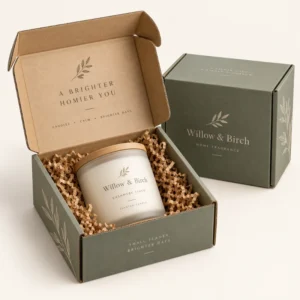
personalized candle boxes are printed boxes made to fit a specific candle, whether it is a jar candle, a tin candle, a pillar candle or a votive, and to present that candle as a finished product rather than as a loose item. They protect glass and wax in storage and in transit, they carry scent notes, safety information and brand artwork, and they make a candle ready for a shop shelf, a market stall or a gift. For a candle maker, the box is often the first thing a buyer sees, before the scent is even sampled.
Why personalized candle boxes matter for candle makers
Candles are bought with the senses, and packaging shapes that first judgement. A jar candle in a plain transit carton looks unfinished, even if the wax and fragrance are excellent. The same candle in a well fitted printed box looks like a considered product, with a clear scent name, a readable label and a finish that matches the fragrance. That presentation matters in retail, where a customer may choose between several candles on a shelf, and it matters online, where the box is photographed and shared.
Protection is equally important. Glass jars can chip, tins can dent, and pillar candles can scuff or pick up dust. A box that fits closely, with an insert or a snug base, stops movement and reduces damage. Wax is also sensitive to heat and to surface marks, so a box that keeps the candle upright, shielded from direct light and separated from other items will help it arrive in the condition the maker intended. Good fit is therefore not a luxury detail, it is a practical safeguard for a fragile product.
Information on the box helps the buyer use the candle safely and enjoy it fully. Scent notes, burn guidance, wax type and care notes are all useful on a box or on an insert, because the customer may not keep a separate leaflet. Keep safety wording clear and legible, and avoid covering it with a sticker or a seal. A buyer who understands how to burn a candle safely is more likely to enjoy it and to buy again.
Fitting the box to jar, tin and pillar candles
Jar candles need a box that holds the jar upright and prevents it rolling or knocking against other items. Measure the jar diameter and height, including the lid, and add a small allowance for an insert. Tin candles are lighter, but they dent easily, so a snug box with a fitted base or a divider is helpful. Pillar candles are tall and often sold without a container, so they need a box that supports the full height and protects the top edge and the base.
Votive and tealight candles are small, and they are often sold in sets. A box for a set needs compartments or a tray that keeps each candle separate, otherwise candles can rub together and mark each other. For a set, test the box with the full set packed, not with a single candle, because weight and fit change when several candles share a box.
Measuring a candle correctly
Measure height, width and depth with the lid on, and note the heaviest point. For a jar candle, the weight is concentrated in the glass and wax, so the base of the box must support that weight without bowing. For a pillar candle, the height is the critical dimension, because a box that is too short will crush the top, while a box that is too tall will let the candle tip.
Materials, print and finish for personalized candle boxes
Cardboard and paperboard are common for retail candle boxes, because they give a clean print surface and a crisp fold. Corrugated board is a better choice for posting, because it absorbs knocks in transit. Rigid board suits luxury candles, because it feels substantial and holds its shape on a shelf, but it adds weight and storage volume. Choose the material that matches how the candle will be sold, not only how it looks in a photograph.
Print can be bold or restrained, depending on the brand. A minimalist brand may use one colour, a simple logo and generous white space. A seasonal brand may use full colour illustration and a pattern that changes with the fragrance. In both cases, keep the scent name large and readable, because that is the detail a shopper looks for first. Keep safety and care text in a size that can be read without a magnifying glass, and place it where it will not be hidden by a price sticker or a seal.
Finishes such as matte lamination, gloss lamination, foil and embossing can add a tactile quality that suits a premium candle. Use them selectively. A foil scent name or an embossed logo can lift a simple design, while foil on every panel can look busy and can hide the scent name. Test finishes under shop lighting, because a finish that looks subtle in daylight can look very different under bright retail lights.
Windows, inserts and gift presentation
A window lets a customer see the candle colour and texture without opening the box, which is useful in retail. A window needs a clear film and a clean cut, otherwise it can look untidy. An insert, by contrast, hides the candle but protects it better and creates a reveal on opening. For gifts, a printed lid message, tissue wrap and a small card often matter more than a window, because the recipient opens the box as part of the gift experience.
Choosing between a window and a closed box
Choose a window when colour and texture are the main selling points and when the candle will be handled in a shop. Choose a closed box when protection, fragrance containment and gift presentation matter more. You can also use a closed box for posting and a window box for retail, with the same artwork adapted for both, if your range sells through both routes.
Ordering and lead times for candle packaging
A clear brief for candle boxes should include candle type, dimensions with lid, weight, number per box, whether the box is mainly for retail display, and whether you need a window, an insert or a special finish. Note any seasonal fragrances and launch dates, because a Christmas or autumn range will need boxes earlier than a core range that sells all year.
After final artwork approval, standard lead times are 10 to 14 working days, corrugated lead times are 12 to 15 working days, and rigid or specialist lead times are 13 to 16 working days. Those figures are a planning guide, not a guaranteed delivery date. Allow time for a printed sample to be checked with a real candle inside, because fit, colour on your chosen board and legibility of safety text are best judged with the product in hand.
Pack a trial box, close it, and handle it as a shop assistant or a courier would. Check for scuffs on the candle, movement inside the box, print that rubs, and a lid that opens easily. Repeat the trial with the heaviest candle in the range, because a box that works for a small tin may not work for a large jar. To plan your order, see the delivery information page, browse the shop for packaging options, request a quote for your candle box design, or explore pillar candle box packaging for tall candles.
Storing candle boxes
Store flat candle boxes in a dry, cool place away from direct sunlight, because heat and damp can warp board and fade print. Keep printed boxes away from strong fragrances in storage, so the board does not absorb scent from neighbouring stock. Label boxes by fragrance and size, so packing for a seasonal range does not become a search through mixed stock.
Frequently asked questions
What size box do I need for a jar candle?
Measure the jar with its lid on, add a small allowance for an insert, and test the box with the real jar inside. The jar should sit upright without rocking, and the lid should close without pressing on the jar.
Are candle boxes suitable for posting?
Yes, if the board and insert are chosen for transit. Corrugated board with a fitted insert is usually better for posting than a light retail carton on its own, especially for glass jars.
Can I print scent notes and safety information on the box?
Yes, scent notes, wax type and care guidance are commonly printed on the box or on an insert. Keep safety text clear and legible, and do not cover it with a seal or sticker.
How long does production take?
As a guide, standard production is 10 to 14 working days after final artwork approval, corrugated production is 12 to 15 working days, and rigid or specialist production is 13 to 16 working days.
Should I choose a window box?
Choose a window when colour and texture help sell the candle in a shop. Choose a closed box when protection and gift presentation matter more, or when the candle will be posted.