
ecommerce product packaging
Showing the single result
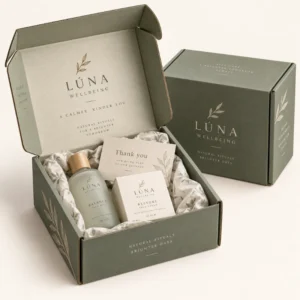
ecommerce product packaging is packaging designed around a specific product sold online, so the box, insert and print all serve that product rather than fitting many products loosely. It protects the item during delivery, shows the brand clearly, and helps the customer understand what they have received as soon as the parcel opens. Good product packaging feels intentional: the size fits, the product sits still, and the opening sequence makes sense.
What ecommerce product packaging should do
Product packaging for online sales has a harder job than shelf packaging, because no shop assistant explains the product and no shelf holds it upright. The box must survive handling, stacking and possible drops, while still looking like a deliberate part of the purchase. It must also carry practical information, such as care guidance, ingredients where relevant, or simple use instructions, in a place the customer will actually see.
The best starting point is the product itself: its shape, weight, fragility, surface finish and sensitivity to moisture, light or pressure. A glass bottle needs different protection from a folded garment, and a set of small jars needs separation that a single item does not. Once those needs are clear, the box size, board, insert and closure can be chosen to meet them without excess material.
Packaging by product type
Cosmetics and skincare suit firm boxes with inserts that hold bottles upright and stop caps rubbing against each other. Clothing suits boxes or mailers that keep garments folded neatly, with tissue or a paper sleeve to reduce creasing and add a finished feel. Food gifts in sealed inner packs suit boxes with dividers that stop packs moving and keep presentation tidy on opening. Electronics and accessories suit inserts that centre the item, protect screens or delicate edges, and keep cables tidy.
Primary pack and outer pack working together
In many online orders the product box and the shipping box are the same item, which simplifies packing and reduces material. Where a separate product box sits inside an outer mailer, the inner box carries branding and presentation while the outer box carries protection and labelling. Decide which role each layer plays before designing print, so branding does not compete with delivery labels and handling marks.
Designing ecommerce product packaging for the customer
Design for the moment of opening. The customer usually opens the parcel quickly, often standing up, and forms an impression within seconds. A clear layout, with the product visible and any message card easy to find, makes that moment feel rewarding. Avoid burying the product under loose filling material or hiding a gift message beneath heavy items. Order inside the box should mirror the care that went into the product.
Colour and finish should match the brand and the product, not simply follow a trend. A calm kraft finish suits natural and handmade products, while a bright white finish suits bold print and photographic detail. Matte finishes reduce glare and fingerprints, while a gloss detail on a logo can draw the eye without covering the whole box. Test print on the actual board, because the same artwork can look different on kraft and on white.
Print that informs as well as brands
Use inside print for information the customer needs after opening, such as how to store the product, how to care for it, or where to find further guidance. Use outside print for recognition and for a short brand message that survives delivery handling. Keep type large enough to read in normal room light, and leave a clear flat area for the delivery label so print does not interfere with scanning.
Inserts, sleeves and cards
Insert cards can carry a thank you note, a discount prompt for a future order, or simple instructions, but they should not replace essential product information on the box itself. Sleeves add a layer of presentation for gift sets and multi item collections, and they can carry a seasonal message without changing the main box. Keep extra items flat and light so they do not add bulk or push the parcel into a larger size band.
Sizing, materials and protection for ecommerce product packaging
Measure the product with any inner pack, bottle cap, seal or garment fold included, because those details change the required internal size. Allow a small margin for the insert thickness and for easy removal, but avoid a large empty gap that lets the product slide. For sets, measure the assembled set rather than adding individual product sizes together, since dividers and spacing change the total footprint.
Board choice follows weight and fragility. Light card suits small, non fragile items that need presentation more than heavy protection. Single wall corrugated board suits most online product orders and gives a good balance of strength and weight. Double wall board suits heavy, fragile or high value products and orders that will travel long distances or through multiple sorting stages. The Royal Mail size and weight guide helps check whether the finished parcel sits within a suitable UK size and weight limit.
Protecting fragile and awkward shapes
Fragile products need protection at corners, edges and any protruding parts, not just a thick outer box. Shaped inserts, card cradles and dividers keep fragile items away from the box walls where impacts land first. Awkward shapes benefit from a box designed around the product outline, with internal supports that stop rotation during transit. Test the pack by turning it and shaking it gently to find movement before approving a design.
Sustainability choices for product brands
Paper based boxes and inserts, minimal plastic and right sized parcels help product brands meet customer expectations on sustainability. Choose board and print finishes that keep the box recyclable in household streams where possible, and avoid unnecessary laminates. A short note inside the box can explain how to recycle the packaging and reuse any insert, which helps customers act on the brand’s sustainability claims.
Ordering ecommerce product packaging for a range
When packaging a range, plan sizes as a family rather than ordering each product in isolation. Two or three well chosen box sizes often cover a whole range more efficiently than a separate size for every item, and they simplify storage and packing. Note which products share inserts, which need unique inserts, and which are sold as sets, because those patterns shape the final specification and quantity for each size.
After final artwork approval, standard orders typically take 10 to 14 working days, corrugated orders 12 to 15 working days, and rigid or specialist orders 13 to 16 working days. These times describe production after approval and are not a guaranteed delivery date. Use the proof stage to check product fit, print colour, label space and opening direction, because changes after approval can delay production.
Getting a useful quote
Include product dimensions, weight, fragility notes, expected quantities per size, board preference, print surfaces and insert needs in a quote request. Mention whether the product box is also the shipping box, and whether gift sets or bundles need a shared size. Related ideas can be explored through ecommerce postal boxes, ecommerce shipping packaging and the shop. For a tailored discussion, use get a quote and visit about us for background on the business.
Checking fit across the range
When samples arrive, pack every product that will use each size, not just the largest item, and check that smaller items still sit securely with their insert. Open each sample as a customer would and look for ink transfer, rough edges or inserts that are hard to remove. Confirm that delivery labels sit flat and that any required product information remains legible after packing and sealing.
Frequently asked questions about ecommerce product packaging
What is the difference between product packaging and shipping packaging?
Product packaging is designed around a specific product and its presentation, while shipping packaging is designed mainly to protect a parcel in transit. In many online orders one box does both jobs, but separating the roles helps when a branded inner box sits inside a protective outer box.
How do I choose a box size for my product?
Measure the product with its inner pack and closure included, add room for the insert, and test a packed sample. Choose the smallest size that holds the product securely without forcing the lid or crushing the contents.
Can product packaging be printed inside and outside?
Yes, many boxes can be printed on both surfaces. Outside print builds recognition on arrival, while inside print suits welcome messages, care guidance and repeat order prompts seen at the moment of opening.
How do I protect fragile products sold online?
Use a shaped insert or divider to centre the product away from the box walls, protect corners and protruding parts, and choose board strength that matches weight and journey length. Test a packed sample for movement before ordering in quantity.
How long does production take after artwork approval?
After final artwork approval, standard orders typically take 10 to 14 working days, corrugated orders 12 to 15 working days, and rigid or specialist orders 13 to 16 working days.