
customized mailing boxes
Showing the single result
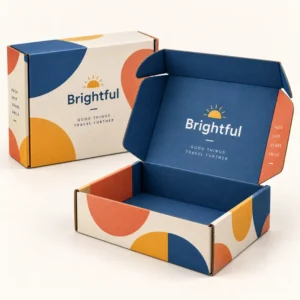
customized mailing boxes are boxes made for posting, sized and printed for documents, books, small goods and subscription parcels that need to travel safely through postal and courier networks. A mailing box is judged first on whether its contents arrive undamaged and in good condition, and second on whether it presents the sender professionally when it reaches the doorstep. A box made for the item, with clear print and a firm closure, does both jobs better than a reused carton that merely contains the item.
Why customized mailing boxes suit postal sending
Postal journeys involve sorting, stacking, handling and delivery in all weathers, so a mailing box needs to be practical as well as presentable. A snug fit stops contents moving, which protects corners, covers and labels. A firm closure stops a box opening in transit, which protects the contents and the reputation of the sender. A clear outside print, with a logo or a simple brand mark, helps the parcel look intentional rather than improvised, which matters for businesses sending review copies, samples, orders and subscription parcels to customers who may never meet the sender in person.
Mailing boxes also help with efficiency. A consistent size for a regular product makes packing faster, because the team does not need to choose a carton and judge filler for every order. A box that ships flat saves storage space, and a box that assembles quickly saves packing time on busy days. For businesses that post regularly, those small savings add up, and they also reduce variation in condition on arrival, because every parcel leaves in the same format, with the same protection, regardless of who packed it.
Choosing a mailing box by what you post
Documents, magazines and catalogues need a flat, firm mailing box or a book wrap style box that stops bending and corner damage. Books need a snug box that matches the closed book, with strong corners for hardcovers and a light, tight fit for paperbacks. Small goods, such as beauty products, stationery and accessories, need a box with an insert or a divider that stops items moving and striking each other. Subscription parcels need a box that can hold a changing set of items while still looking consistent from month to month, which often means a standard external size with internal dividers or tissue that can adapt to different contents.
Postal size and weight considerations
Postal size and weight affect handling, delivery options and the choice of board, so they should be considered at the design stage, not after a box has been ordered. A compact box that holds the product snugly is easier to handle and to store than a large box with empty space, and it usually protects the contents better, because there is less room for movement. Measure the packed product, including any protective wrap, insert or accompanying letter, and test the box with a real parcel before ordering a full run. That test shows whether the closure holds, whether labels sit clearly, and whether the box still looks tidy after handling.
Print, labelling and presentation for mailing boxes
Print for a mailing box should be clear and practical. A logo, a brand colour or a simple pattern can make a parcel recognisable, while a returns address area, a handling note or a simple thank you message can make the parcel easier to use. Keep labels clear of folds and closure areas, so a postal label does not cover important print or peel away from a fold. Keep important information, such as a product name or a safety note, in a position that remains visible when the box is closed and sealed. Artwork should be checked at actual size, because a design that looks good on screen can look crowded or faint when printed on a small mailing box.
Materials and closures for reliable mailing
Corrugated board is the usual choice for mailing boxes, because it absorbs knocks and gives a good print surface for lighter and medium weight parcels. E flute board gives a smooth, slim profile that suits printed mailing boxes for documents and books. B flute board gives extra cushioning for small goods that need more protection. Kraft board gives a natural look and recycles readily, while white board gives brighter colour reproduction for bold artwork. For heavier items, a stronger board or a double wall construction may be needed, and that choice should be based on the weight of the packed parcel and the journey it will take, rather than on appearance alone.
Closure style matters for mailing boxes. A self sealing strip gives a quick, tidy seal for many postal orders. A tuck closure gives a retail style finish that suits subscription and gift parcels. A tape sealed carton gives a firm seal for heavier parcels that need extra security. In each case, the closure should be tested with a real parcel, because a closure that looks neat on an empty box can strain when the box is full, and a strained closure is more likely to open or to damage print at the seal. For a related presentation format, see customized mailer boxes for online orders and unboxing.
Sustainability and reuse for mailing boxes
Many businesses now want mailing boxes that are easy to recycle and, where possible, easy to reuse. Recycled board, uncoated kraft and water based inks can reduce impact, provided the board grade still protects the contents on the actual journey. A fitted mailing box that needs little filler is often more sustainable than a larger box with loose filler, because it uses less material and less space in transit. Clear recycling guidance on the box can help recipients dispose of it well. A sturdy mailing box that can be reused for a return or for storage can also extend its useful life, which is worth considering when choosing board and closure.
Avoiding waste from oversized mailing boxes
Oversized mailing boxes create waste in several ways. They use more board, they need more filler to stop contents moving, they take more space in storage and in transit, and they can collapse into empty space if stacked under heavier parcels. A box made to the packed product avoids those problems, and it usually looks better on delivery, because a compact parcel feels more considered than a large, half empty carton. Regularly reviewing box sizes against actual products can catch drift, where a box ordered for one product gradually gets used for smaller products that do not need it.
Ordering and delivery for mailing boxes
A clear quote starts with internal size, quantity, board, closure, print and finish. State what will be posted, whether artwork will be printed inside, outside or on both surfaces, and whether the box is for a single product or a range of postal items. If quantities vary by size, say so early, because a shared print design across sizes can keep branding consistent while each size still gives a proper fit. Proofs are worth their time for a new mailing box, especially where a postal label area must stay clear and where a closure could cover part of the print if the size is slightly out.
Lead times after final artwork approval are 10 to 14 working days for standard boxes, 12 to 15 working days for corrugated boxes and 13 to 16 working days for rigid or specialist boxes. Plan a mailing, a subscription send or a product launch around those times, with room for proof approval and packing. Full details are on the delivery information page. To begin, request a quote for customized mailing boxes or browse the full shop for packaging ranges. Before posting small parcels, check the Royal Mail parcel postbox guidance for drop off size limits.
Frequently asked questions about customized mailing boxes
Question: What are customized mailing boxes?
Answer: They are boxes made for posting, sized and printed for documents, books, small goods and subscription parcels, with a closure and board chosen for postal handling.
Question: How are mailing boxes different from mailer boxes?
Answer: The terms overlap, but mailing boxes are often described by their postal use, while mailer boxes are often described by their retail style opening and unboxing. The right choice depends on the product, the closure and the presentation you want.
Question: Can customized mailing boxes be printed inside and outside?
Answer: Yes. Outside print carries brand recognition on delivery, while inside print can carry a message, a pattern or simple guidance that the recipient discovers on opening.
Question: What size mailing box should I choose?
Answer: Choose a size based on the packed product, including wrap, inserts and any letter, with just enough clearance to pack and unpack without force, and test it with a real parcel before ordering.
Question: How long does production take after artwork approval?
Answer: Standard boxes take 10 to 14 working days, corrugated boxes take 12 to 15 working days and rigid or specialist boxes take 13 to 16 working days after final artwork approval.