
custom printed packaging
Showing the single result
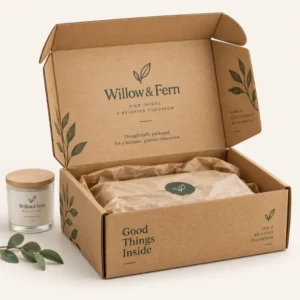
Custom printed packaging is packaging printed with your branding, covering product boxes, mailer boxes, postal boxes and gift styles that work together as one range. It lets a brand present every product, order and gift in a consistent way, so customers recognise the brand whether they meet it on a shelf, in a parcel or at an event. For a growing business, that coherence is often what turns good products into a memorable brand.
What custom printed packaging includes
Custom printed packaging is a broad term, and it helps to think of it as a system rather than a single box. Product boxes present items on a shelf or at a market stall, mailer boxes carry online orders, postal boxes protect items in transit, and gift boxes add a special finish for sets and occasions. When those styles share colours, logo placement, typefaces and finishes, the whole range feels intentional, even when individual boxes serve very different jobs.
Print can also extend beyond the box itself. Inserts, sleeves, belly bands and inner cards can carry product information, care guidance, a thank you message or a seasonal design, without changing the main box. Those smaller printed pieces are useful for testing a new design or a limited edition, because they can change more often than the main packaging, while the core brand look stays stable.
Product boxes, mailer boxes and gift boxes compared
Product boxes prioritise shelf presence and product information. They need clear branding, legible text and a structure that displays well, whether standing upright or stacked. Mailer boxes prioritise protection and a clean opening, with a closure and board that survive posting. Gift boxes prioritise the opening experience, with a tidy interior, a satisfying lid or flap, and room for tissue, a ribbon or a card. A brand that sells in several channels will often need more than one of these styles, but they should still look like they belong together.
Choosing a lead style for your range
Start with the channel that matters most to your business. A retail led brand may start with a product box and add a postal outer later, while an online led brand may start with a mailer box and add a retail box only when it enters shops. A gift led brand may start with a gift box and adapt it for posting with a stronger board or an outer. Choosing a lead style first keeps the range focused and avoids a collection of boxes that look unrelated.
Materials and finishes across a packaging range
Materials should follow product weight, fragility and selling route, not fashion alone. Kraft board gives a natural, warm feel and suits artisan and eco conscious brands. White board gives a clean surface for bright colour and detailed artwork. Corrugated board adds strength for posting and for heavier items. Rigid board gives a firm, premium feel for gift sets and keepsake ranges. Using the same board family across a range, where practical, helps colours and finishes look consistent.
Finishes that lift a design without cluttering it
Finishes should highlight, not overwhelm. Matt lamination gives a soft, understated feel, gloss adds colour depth, foil highlights a logo or a key word, embossing adds texture, and spot gloss can draw attention to a pattern or a name. Use one or two finishes with purpose, rather than combining several on every box, because restraint usually reads as more premium than a crowded set of effects. Check finishes on a proof, because they can change how colours and text appear.
Building a coherent custom printed packaging range
Coherence comes from a small set of rules applied consistently. Use the same logo version, the same core colours and the same approach to type across boxes, even when sizes differ. Keep information in similar places, such as product name on the front, care guidance on a side panel and a brand message inside the lid, so customers learn where to look. When a new product joins the range, it should feel like part of the family at once, not like a separate brand.
Think about the customer journey as a whole. A customer may first see a product box in a shop, then order online and receive a mailer box, then receive a gift box for a special occasion. If each of those boxes feels different, the brand feels fragmented. If they share a clear visual language, each encounter reinforces the last, and the customer is more likely to remember the brand and return.
Briefing a packaging project clearly
A clear brief saves time and avoids costly changes. Include product dimensions and weight, selling route, order volumes, the look you want, artwork you already have, and any information that must appear on the box, such as safety wording or care guidance. Note any constraints, such as a label area, a need for food contact suitability, or a requirement to fit a particular shelf or postal size band. The more specific the brief, the more accurate the advice and the quote will be.
Proofing and approving a full range
Proof each box size and style, not just the main one, because artwork can behave differently at different sizes. Check spelling, product names, colours, alignment and fold positions on every proof, and fold a proof into shape where possible to see how the design works in three dimensions. Approve the range as a set, so you can spot a colour or logo difference between boxes before production, when it is still easy to correct.
Ordering custom printed packaging from Personalized Mailer Boxes
Share your product range, selling routes, sizes and artwork, and request a quote for a packaging range built around your brand. Standard lead times after final artwork approval are 10 to 14 working days, corrugated styles take 12 to 15 working days, and rigid or specialist styles take 13 to 16 working days. These are production lead times, not a guaranteed delivery date, so allow extra time for proofing a full range and for seasonal demand.
You can explore related options through custom printed mailer boxes for online orders and custom printed kraft boxes with a natural look, browse the shop for packaging ideas, learn more on the about us page, and when you are ready use the get a quote page to send your brief.
Frequently asked questions about custom printed packaging
What counts as custom printed packaging
It covers printed product boxes, mailer boxes, postal boxes, gift boxes and related printed pieces such as inserts and sleeves, all carrying your branding. A coherent range uses shared colours, logo placement and finishes across those styles.
Should all my packaging look identical
Not identical, but coherent. Boxes for different channels can differ in size, board and structure, while sharing logo, colours, type and finish, so they clearly belong to the same brand.
Can I start with one box style and add more later
Yes, starting with a lead style for your main selling channel is often wise. Keep a record of colours, board and finishes, so later boxes can be matched to the original range.
How do I brief a packaging supplier clearly
Include product size and weight, selling route, volumes, artwork, required wording and any constraints such as label space or shelf size. A specific brief leads to more accurate advice and a more accurate quote.
How long does custom printed packaging take after artwork approval
Standard boxes usually take 10 to 14 working days after final artwork approval, corrugated boxes 12 to 15 working days, and rigid or specialist boxes 13 to 16 working days. Allow extra time for proofing a full range.