
custom corrugated shipping boxes
Showing the single result
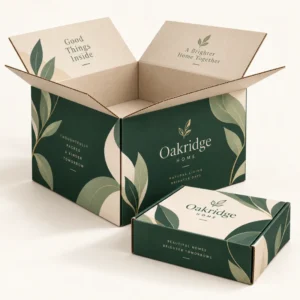
For heavier courier parcels, custom corrugated shipping boxes are strong transit boxes made to your dimensions and printed with your branding for courier and postal delivery. They are designed to survive stacking, depot handling and longer journeys without losing shape or letting the contents move. For heavier orders, multi item parcels and repeat trade sends, a shipping box gives more protection than a slim mailer.
What custom corrugated shipping boxes are built for
A shipping box has a different job from a presentation mailer. It must carry weight, resist compression from boxes stacked above it, and stay sealed through several handling stages. Corrugated board meets that brief because the fluted core cushions impact while the liners keep the box rigid. When the box is sized correctly, the product sits snugly, the tape seal stays flat, and the label remains easy to scan.
Many businesses use a plain brown shipping box for the outer journey and keep the branded experience inside, with a printed mailer, tissue or a card. Others print the outer box itself, so the brand is visible from the moment the parcel arrives at the door. Both approaches work. The choice depends on whether the outer box will be seen by the end customer, whether it will pass through a retail chain, and how much handling it will face before it is opened.
Board grades and box styles for transit
Single wall board suits light to medium parcels, such as apparel orders, books and small homeware sets. Double wall board suits heavier goods, such as tool kits, bulk food packs, large candle sets and boxed electronics, where stacking strength matters. A regular slotted carton, with flaps that meet in the middle, is the workhorse style for warehouse packing because it is fast to assemble and tape. A full overlap carton gives extra strength at the base and top, which helps for very heavy contents.
Flute choice also matters. E flute gives a neat, printable surface for lighter shipping boxes. B flute gives a good balance of strength and crush resistance for general courier use. C flute gives deeper cushioning for larger, heavier parcels. If a parcel will be stacked on pallets or stored for a period, tell the supplier about the stack height and storage conditions, so the board grade can be matched to the real load rather than to a guess.
Matching the box to weight and handling
Weigh a fully packed sample, including inserts and filler, and use that figure when choosing board. Check the closure by lifting the sealed box by its base and by its sides, and by turning it gently to see if contents shift. If the contents move, add a divider, a shaped insert or a tighter internal size before ordering in volume. A box that passes a simple in house handling test is far more likely to arrive intact after courier transit.
Packing custom corrugated shipping boxes for courier journeys
Good packing starts with the right internal size. Leave only enough room for the protection the product actually needs. Too much empty space invites movement and damage, while too little room puts pressure on the flaps and the tape seal. Place heavier items at the bottom, protect corners and edges, and keep fragile items away from the outer walls where impact is most likely. Use dividers for bottles, jars and sets, so items cannot knock together.
Taping technique matters as much as board choice. Seal the centre seam fully, run tape a short way down each side, and check that the tape bonds to a clean, dry surface. For heavy parcels, a second strip across the centre seam adds security. Place the address label on the largest flat panel, clear of folds and tape edges, so it scans first time. If the parcel needs a returns label or a handling note, place it where it will be seen without covering the main address.
Print and branding on a transit box
Print on a shipping box can be simple and still effective. A logo, a web address and a short handling note are often enough, and they keep the design legible after handling. Full colour print across the whole box suits brands that want the outer parcel to carry the full brand story. Single colour print on kraft board suits a practical, understated look and keeps the focus on clear labelling. Inside print is less common on a shipping carton, but it can carry a thank you note or a returns instruction that the customer sees on opening.
Consider how print will survive transit. Bold shapes and clear text hold up better than fine detail on a box that will be handled, stacked and possibly exposed to damp. Matte finishes resist scuffing, while a simple kraft surface hides minor marks well. If the box will be seen by the end customer as well as shipped, ask about a whiter liner and a cleaner print finish, so the same box can serve both roles without looking like a plain transit carton.
Returns, storage and repeat orders
If returns are common in your trade, choose a closure that can be resealed cleanly or add a second tape strip area and a clear returns instruction inside the lid. Store flat packed boxes in a dry place, stacked by size, with the specification label visible so staff pick the right box first time. Keep artwork and board specification on file, so repeat orders match earlier runs in size, print and strength. That consistency reduces packing errors and keeps customers familiar with your parcels.
Ordering custom corrugated shipping boxes
Begin with a list of your most common parcels, from the smallest single item order to the largest multi item kit. Note the weight and dimensions of each packed parcel, the courier or postal service you use, and any stacking or pallet requirement. Share those details with your enquiry, along with print ideas and the quantity you expect to use over a season. A supplier can then recommend a small range of sizes and board grades that cover most orders, rather than a single box that fits none of them well.
Lead time for corrugated boxes is 12 to 15 working days after final artwork approval. That timing covers production after artwork is agreed, and it is not a guaranteed delivery date, so build in extra time for peak trading periods and for any proof changes. Order a packed sample first if the contents are fragile, heavy or high in value, and test it through your normal packing and courier route before committing to a large run.
To start, you can request a quote with your parcel sizes and weights. You can also check the delivery information page, explore the shop range for packaging ideas, or read the about us page for background on the business.
Common mistakes to avoid
Do not choose a box by outer size alone, since internal size decides how the product sits. Do not rely on filler to fix a box that is far too large, since filler adds weight, cost in handling time and waste for the customer to dispose of. Do not print fine text that will be lost after handling, and do not place labels across folds where scanning can fail. A short trial with real packed samples will reveal most of these issues before they affect customers.
What to include in your enquiry
Include packed dimensions, packed weight, product type, board preference, box style, print areas, quantity and posting method. Add notes on stacking, pallet use, returns and any fragile contents. With that information, the specification can be set correctly at the first attempt, and the proof will show a box that reflects your actual parcels.
Frequently asked questions
Question 1: How are shipping boxes different from mailing boxes?
Answer: Shipping boxes are generally stronger and deeper, built for courier handling, stacking and heavier contents. Mailing boxes are slimmer and often focus more on presentation for light postal goods.
Question 2: Do I need double wall board?
Answer: Double wall board is worth considering for heavy, fragile or high value parcels, and for parcels that will be stacked or stored. Light to medium parcels often ship well in single wall board of the right flute.
Question 3: Can shipping boxes be printed?
Answer: Yes. You can choose a simple logo print, full colour print, or a plain outer box with branded contents inside, depending on who will see the parcel and how it will be handled.
Question 4: How long does production take?
Answer: Corrugated boxes take 12 to 15 working days after final artwork approval. Allow extra time for samples, proof changes and peak periods.
Question 5: What if my products vary a lot in size?
Answer: A small range of box sizes usually covers most orders better than one size for everything. List your common parcels and choose sizes that keep filler and movement to a minimum.