
cardboard box mailers
Showing the single result
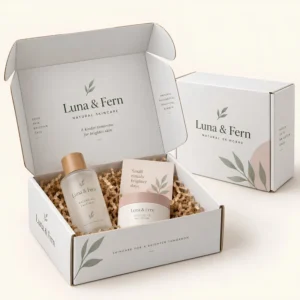
cardboard box mailers are postal boxes designed to do two jobs at once: protect an order in transit and present it well when it is opened. They close with a tuck flap or a seal strip, fold into a neat rectangular parcel, and give a clean outer face for a label and a printed design. Online sellers, subscription brands and gift businesses use them because the box itself becomes part of the customer experience.
The term covers a broad family, from plain kraft mailers for everyday orders to fully printed mailers with colour inside and out. What they share is a shallow, tidy shape that suits items such as cosmetics, apparel, stationery, small electronics and curated gift sets, where presentation matters as much as protection.
Why cardboard box mailers suit online orders
A mailer box arrives as a finished package rather than as a plain shipping carton that needs extra wrapping. The customer opens one flap and sees the product, often with tissue, a thank you card or a simple insert on top. That first impression can shape how the customer feels about the brand, and it can encourage repeat orders and recommendations.
Protection with a neat profile
Mailer boxes are usually shallow, which keeps products from moving around and keeps the parcel easy to stack and store. Corrugated board gives crush resistance in plain terms: it helps the box hold its shape when other parcels press against it. For fragile items, add a fitted insert or a layer of cushioning so the product stays centred and does not touch the walls.
Self sealing and tuck flap styles
Self sealing mailers use an adhesive strip for fast packing, which suits high volume fulfilment. Tuck flap mailers close without adhesive and can be opened and closed again, which helps with returns and with customers who want to keep the box. Choose the closure that matches your packing speed, your return policy and your customer experience.
Styles of cardboard box mailers
Mailer boxes come in several constructions, and the right one depends on the product, the packing process and the look you want. A crash lock base assembles quickly and suits fast packing lines. A tab lock or tuck end box gives a clean finish for retail style presentation. A mailer with a tear strip opens easily and feels considered, because the customer does not need to cut into the box.
Plain, printed and fully branded mailers
Plain kraft mailers suit sellers who want a natural, understated look and who add branding with a label, a stamp or an insert. Printed mailers carry a logo or a pattern on the outside, while fully branded mailers continue the design inside, so the unboxing feels complete. Start with the outside if budget is tight, because that is what the customer and the courier see first.
Colour and finish choices
Kraft board gives a warm, natural appearance and pairs well with simple black or single colour print. White board gives a brighter base for full colour designs and for crisp product photography if customers share the unboxing online. A matte finish looks understated, while a glossier finish can make colours feel bolder; test a printed sample under normal light before approving a full run.
Sizing cardboard box mailers for your products
Measure each product with its usual insert or cushioning, then choose a mailer that holds it snugly without forcing the lid shut. A mailer that is too deep lets small items slide, while one that is too tight can crush tissue or bend a card insert. Keep a short list of two or three mailer sizes that cover most of your range, rather than a separate size for every product.
Fitted inserts and dividers
Inserts hold products in place, separate items that could scratch each other, and make the unboxing look intentional. A simple cardboard divider can be enough for two small items, while a fitted insert suits a hero product that should sit in the centre of the box. Test inserts with the real product and the real packing routine, because an insert that looks good empty may be awkward to load at speed.
Checking the finished parcel
Once packed, check that the mailer closes flat, that the label sits on a smooth face, and that the parcel meets the size and weight limits of your postal service. The Royal Mail guidance on sending small parcels gives maximum small parcel sizes and advice on sturdy boxes, sealing and labelling that applies to mailer boxes as well as plain postal boxes.
Branding and the unboxing experience
Good branding on a mailer box is clear, simple and easy to read at a glance. A logo, a short message and a consistent colour are usually enough; a crowded design can look busy and can fight with the delivery label. Leave a clear label area on the outer face, and keep important text away from folds and seams where it can distort.
Inside print and inserts
Inside print can carry a welcome message, care instructions or a simple pattern that surprises the customer on opening. Inserts can do the same job at lower cost, and they can change with seasons or promotions without reprinting the box. Many brands use both: a consistent printed box plus a changing insert that keeps each order feeling fresh.
Sustainability in mailer design
Cardboard mailer boxes are widely recyclable when clean and dry, and many use recycled content. Avoid plastic lamination and mixed material extras where you can, because they can complicate recycling. Tell customers briefly how to recycle the box, and keep void fill to paper based materials if you want the whole parcel to stay easy to recycle.
Ordering printed cardboard box mailers
Before ordering, confirm the mailer size, the board, the closure, the print areas and the quantity, and ask for a sample or a proof if one is available. Check the proof for label space, fold positions and colour on kraft or white board, because print can look different on board than on screen. For related postal box options in quantity, see cardboard boxes for shipping on this site.
For printed corrugated packaging, the site gives lead times after final artwork approval at 12 to 15 working days. Use that as a planning guide rather than a guaranteed date, and build proofing time into your launch plan. To discuss sizes, print and quantities, use the request a quote page and share details of the products the mailer must hold.
Frequently asked questions
What is a cardboard box mailer?
It is a shallow postal box, usually made from corrugated board, that protects an order and presents it neatly on opening. It differs from a plain shipping carton because it is designed for presentation as well as protection.
Are mailer boxes suitable for fragile items?
Yes, with the right insert or cushioning. Keep the item centred, protect every side, and choose stronger board or a fitted insert for glass, ceramics or electronics.
Can cardboard box mailers be printed?
Yes, with a logo, a pattern or a full design on the outside, and inside print if you want a complete branded unboxing. Keep a clear space for the delivery label and test print on your chosen board before a full run.
Do mailer boxes need tape?
Self sealing mailers do not, because the adhesive strip closes the box. Tuck flap mailers may benefit from a strip of tape for security on longer journeys, especially for heavier orders.
Are cardboard box mailers recyclable?
Most are recyclable with paper and card recycling when clean and dry. Remove tape, labels and non paper inserts where practical, and avoid plastic lamination if easy recycling matters to your customers.