
candle packaging boxes
Showing the single result
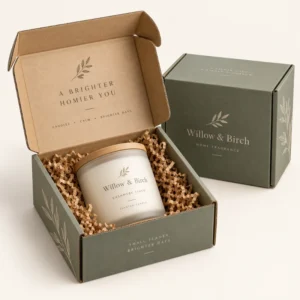
Candle packaging boxes are the boxes that protect, present and brand candles for retail, gifting and online selling. They cover everything from a simple tuck end box for a single jar to a rigid gift box for a premium collection. The right candle packaging boxes make a candle easier to sell, safer to handle, and more enjoyable to receive, all at the same time.
How candle packaging boxes work across a whole range
Most candle makers do not sell just one candle. They sell a range of scents, sizes and vessel types, and the packaging needs to hold that range together as a brand. A consistent box style, colour palette and typeface across scents helps customers recognise the brand instantly, even when they are choosing a new scent. At the same time, each box must fit its own candle properly, because a range that looks consistent but fits badly will still lead to breakages and complaints.
A good approach is to standardise the design system and vary only the size and the scent information. Use the same board, the same finish and the same layout, but cut each box to its candle. That keeps the range looking like a family on a shelf, while giving each candle the fit it needs. It also simplifies reordering, because the printer already knows the design system and only the dimensions change.
Boxes for different candle types
Jar candles need a box that supports weight and protects glass, with an insert where the jar is heavy or tall. Tin candles are lighter and more forgiving, so a simple card box often works well and keeps the range light for posting. Pillar candles need a tall, stable box that stops the candle tipping, while votives and tealights suit smaller boxes, often in multiples, with dividers to keep them separated.
Matching box to selling channel
Retail boxes need to stack, stand upright and look good under shop lighting. Market stall boxes need to be sturdy enough for repeated handling and easy to open for customers who want to smell the candle. Online boxes need to survive posting, either as a mailer in their own right or inside a corrugated outer. A box that works in a shop may not work in the post, so plan for the main selling channel first.
Materials in common use
Cardboard remains the most versatile material for candle boxes, offering good print quality and a range of finishes at a practical weight. Kraft board suits natural, artisan and eco conscious brands. White board suits bright, modern designs and photographic artwork. Rigid board suits luxury ranges and gifts, where weight and presence matter more than flat packing. Corrugated board suits shipping, where cushioning and strength matter most.
Recyclability is increasingly important to buyers. Card, kraft and corrugated board can usually be recycled through household paper recycling, provided any plastic window or lamination is considered. If sustainability is central to your brand, discuss board choice and finishes with your supplier, and avoid finishes that complicate recycling unless they are essential to the design.
Print, finishes and branding
Print is where a candle box becomes a brand asset rather than just a container. A clear logo, a readable scent name and a consistent colour system help a candle stand out on a crowded shelf. Full colour print suits illustration and photography, while a limited colour design on kraft can look equally premium when the layout is confident and the type is well chosen.
Finishes add the final layer of character. Matte lamination gives a soft, modern feel. Gloss lamination gives vivid colour. Soft touch lamination gives a velvety surface that invites handling. Foil, embossing and spot gloss can highlight a logo or a single design detail. As with any design, one or two strong details usually work better than many competing ones.
Information every candle box should carry
Every candle box should carry the scent name, the candle type, and any safety guidance that applies to the product. Burn guidance, such as trimming the wick and keeping the candle away from draughts, is helpful for first time buyers and shows care from the maker. Keep safety wording legible and clear of folds, so it remains readable after the box is assembled.
Artwork and proofing for a range
When artwork covers several scents, check every scent name against its jar label, and check that colours remain consistent across the range. A proof for one box size does not guarantee fit for another, so check a sample for each size, ideally with the real candle inside. That step catches sizing errors, colour shifts and text problems before a full run.
Planning, quantities and lead times
Planning a range starts with listing every candle type, its dimensions and its expected sales. High volume scents may justify their own box size, while slower scents can share a box size if their dimensions are close. Ordering a consistent design system across the range keeps the brand coherent and makes future reorders faster, because the core artwork is already approved.
After final artwork approval, standard boxes are typically ready in 10 to 14 working days, corrugated boxes in 12 to 15 working days, and rigid or specialist boxes in 13 to 16 working days. These are production lead times, not a guaranteed delivery date. Allow time for proofing and for any changes, and order ahead of seasonal peaks such as Christmas, Mother’s Day and Valentine’s Day.
To plan your range, request a quote with your candle sizes and box styles. You can also look at a single candle packaging box, compare candle jar packaging boxes, or learn about Personalized Mailer Boxes.
Frequently asked questions
What is the most popular style of candle box?
The tuck end box is the most widely used style, because it packs flat, closes neatly and suits retail and online selling. Lid and base boxes are popular for gifts and premium ranges, while sleeve boxes suit brands that want a more modern opening.
Can one design work for jars, tins and pillars?
The design system can stay the same, with the same colours, logo and layout, but the box size and structure should change to fit each candle type. A shared design with tailored sizes gives consistency without compromising protection.
Are candle boxes recyclable?
Most card, kraft and corrugated candle boxes can be recycled through household paper recycling. Check the specific board and finishes with your supplier, especially if the box includes a plastic window or a heavy lamination.
How do I choose between matte and gloss finishes?
Matte suits calm, premium and natural brands and hides fingerprints well. Gloss suits bright, vivid designs and photographic artwork. Soft touch lamination offers a third option, with a velvety feel that suits luxury ranges.